Jekyll2025-04-30T07:05:29+00:00https://www.coryzue.com/feed.xmlCory Zue | Full-Stack Developer, Maker of Products, and SolopreneurCory Zue is a software developer, aspiring entrepreneur, and occasional blogger. He's currently working at Dimagi and launching projects on the side.
Cory ZueI spent the last day using MCP and it kind of blew my mind2025-04-04T00:00:00+00:002025-04-04T00:00:00+00:00https://www.coryzue.com/writing/holy-mcpYesterday morning I got a text from a friend in tech that said this:
Claude Code, well configured, is a 10xer
I’ve used Claude Code some—and
while I’ve found it useful, especially for tasks that involve discovering and navigating multiple files—I
wouldn’t say it’s had anything close to a 10x productivity boost for me.
So I asked him what “well configured” meant, and this was his response:
Basically a well written Claude.md, MCP servers for all your tools, and a well defined set of commands Claude should run
If you’re like me—trying to keep up with the latest in development and AI tooling, but also totally overwhelmed by the pace
of things—you’ve probably heard people talking about MCP but may not have tried it.
This text exchange convinced me to give it a shot, and I spent the last 24 hours learning about
MCP and trying to figure out how I can use it to help me write code.
This post covers everything I’ve learned about MCP in the last day—while I still have
beginner’s mind.
It is by no means a definitive guide to MCP, just one person’s perspective on using it for a day.
TL;DR: MCP is pretty incredible.
What is MCP?
MCP stands for “Model Context Protocol”. It was created by Anthropic
and is basically a standard for letting AI assistants work with data and APIs.
In the past few months it’s been increasingly adopted by other tools and has emerged as the standard
for this use case.
Big picture, MCP operates like a client/server architecture where the clients are LLMs and the servers are tools.
Claude (Desktop and Code), and IDEs like Cursor and Windsurf are the most popular clients,
though there are others.
Servers “register” with the client through your configuration, and then offer two main capabilities:
Discovery: essentially telling the client what tools the server has and how to call them.
Tool use: calling the tools and getting back the results.
Then, the client uses LLM magic to determine when one of the server’s capabilities might
be a good fit for responding to a prompt, and automatically calls the tool in the appropriate way as needed.
Basically it gives your LLMs new powers!
Note: I don’t know how any of this works under the hood.
But I assume you could figure out the details if you read the spec.
My experience was that they could both use tools reasonably well, but Cursor was quite bad at discovery,
and I had to nudge it a lot before it would use the tool I wanted it to.
It also sometimes used the tool in a dumb way, e.g. failing to inspect the schema of a table before making queries against it,
and then giving up when it ran into errors.
Cursor MCP support is new, and I’m sure it’ll improve.
Claude Code, on the other hand, was a complete beast—it was great at choosing tools,
understanding the order of operations of using them, and delivering the right results.
The rest of these examples will focus on Claude Code,
though you could theoretically try these things in any MCP client (I think?).
MCP Servers
MCP servers are basically wrappers around a particular tool.
There are tons of MCP servers out there and I only scratched the surface of a few—but once you do that
you can see the potential to unlock crazy workflows.
There’s a list of servers here you can start with.
Servers can do anything from access your database, connect to SaaS tools like Linear, Github, and Slack,
and even control a web browser.
Setting things up
The most wild part of this is just how easy it is to set up.
Most of the servers can be run in a single docker, uv, or npx command,
and to connect them to a client you just create a JSON file with the arguments needed to run them.1
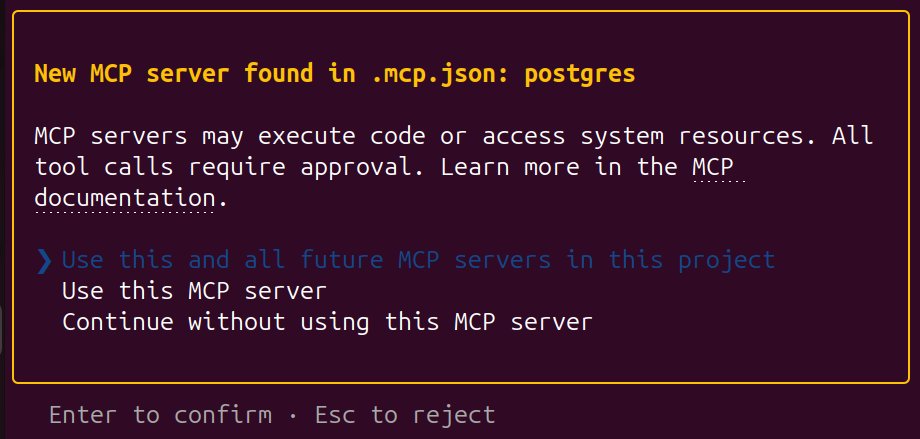
Once you save that file and restart claude you’ll be prompted to enable the MCP tools:
Claude confirming you want to give it free reign to access your database.
After confirming, you can just start… asking questions!
I connected it to a local copy of my SaaS Pegasus database
and just fired away.
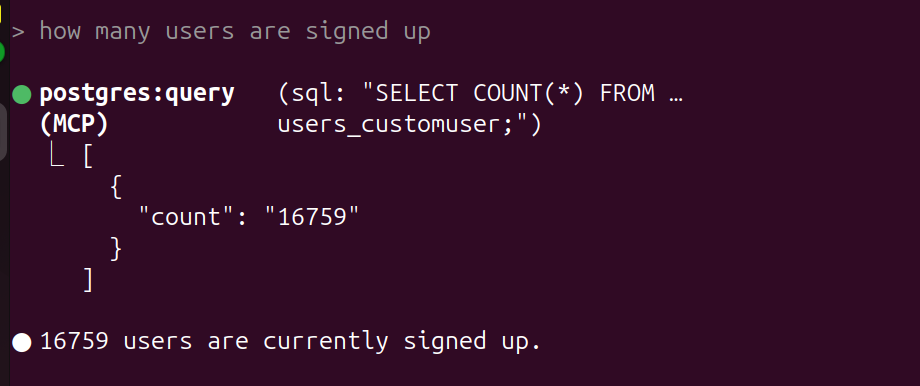
Here’s how it handled “how many users are signed up”:
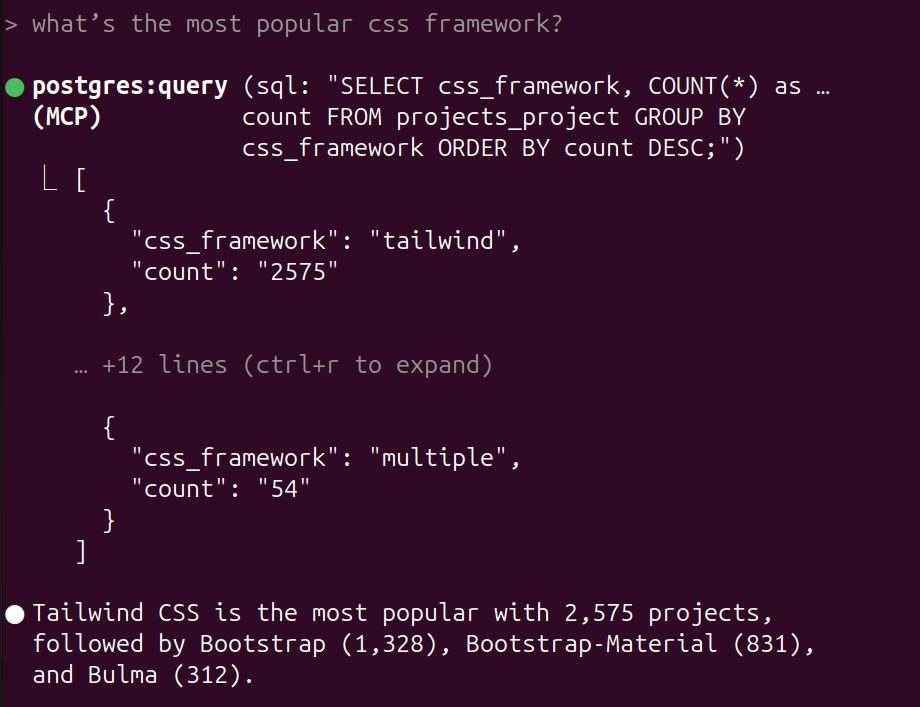
Or “what’s the most popular css framework?”:
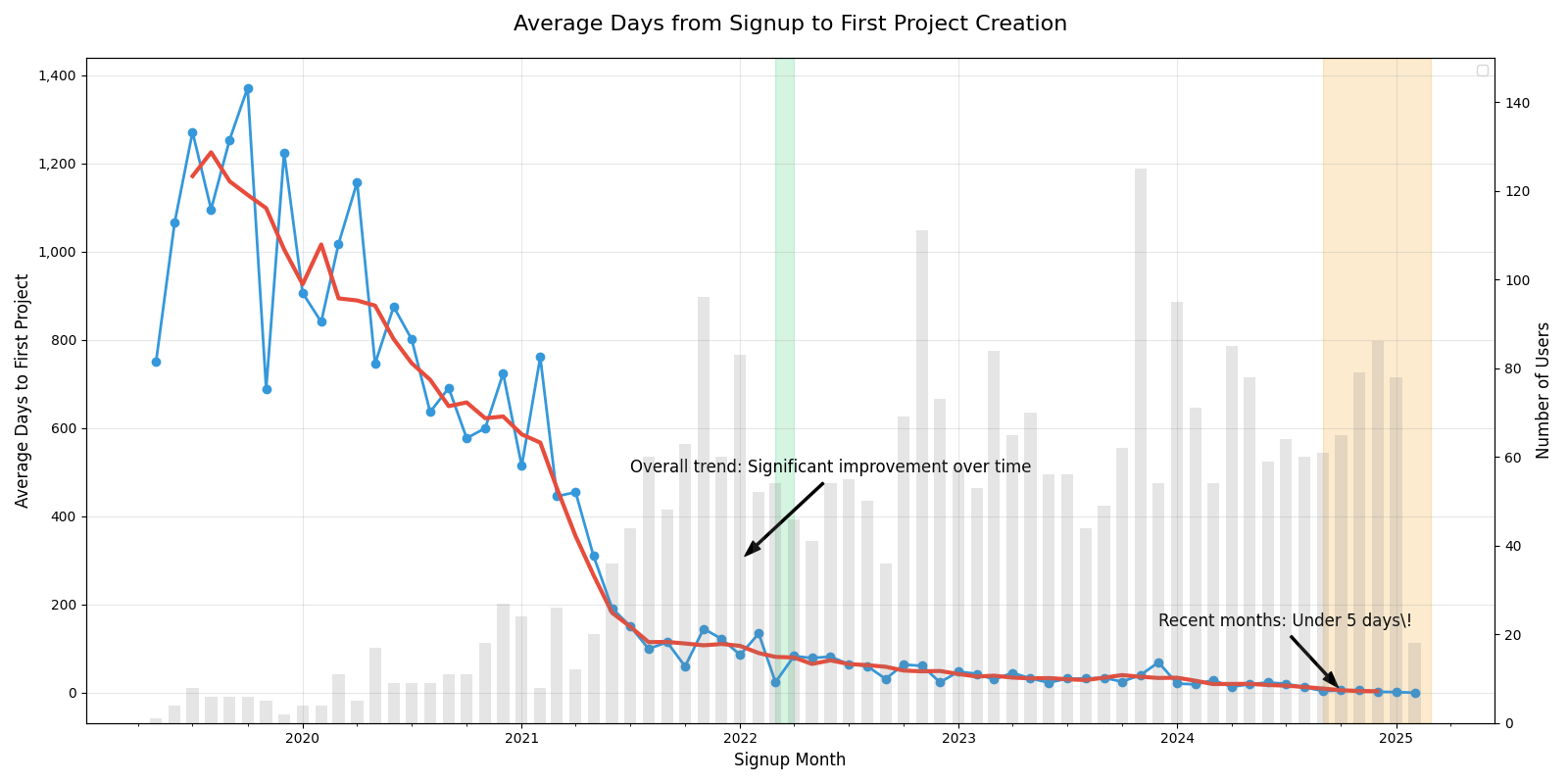
On a complete lark, I asked it “Can you generate a plot showing the average duration between signing up and creating your first project?”
And—I shit you not—it one-shotted a Python script that outputted this chart (including coloring and annotations):
This is insane! Companies have invested millions upon millions of dollars inventing “chat with your database” tools,
and now you can now build your own with a few lines of JSON!
This entire exchange cost 63 cents by the way.
Controlling a browser
The other fun use case I played with was giving Claude access to my web browser.
In the first one I gave Claude a URL that was generating a 500 error in my local app.
Claude loaded the page in a browser, read the stack trace, then found and fixed the bug and confirmed
the page was working again.
In the second one I intentionally introduced a layout issue on a page and told Claude to find and fix it.
Once again, it saw the issue, fixed the bug, and then verified it looked good in the browser.
If you want, you can watch that exchange in this video here.
In both of these cases the browser use was more of a gimmick, and I could have fixed the bug faster with
my own knowledge. But it was still pretty cool to see it working!
I don’t yet know if I’ll use the browser tool regularly, but it’s fun to have in the toolkit.
MCP and Security
It is worth caveating here that you should definitely only run MCP servers you trust!
Any time you let an AI do stuff on your behalf you are taking risks and you need to be comfortable with those risks.
It is quite easy for a malicious
tool author to do bad things with MCP without your knowledge.
Conclusion
Overall, this experience really changed my perspective on MCP.
I no longer think it is over-hyped.
The possibilities that are opened by this really are mind-blowing.
With the right set up, I can see a path to a world where agents find tickets in your issue tracker, fix them,
verify the fixes with tests and in a browser, submit pull requests, and do code review.
Yes, it won’t work all the time and yes, we’ll want humans in the loop on this for a long time—but
the road to the agentic future is now becoming clearer in my mind where before it was pretty hand-wavey.
What a world!
MCP is also no longer a scary mystery that I don’t understand.
It’s another tool—almost a meta-tool—that I can now reach for whenever I need to give my LLMs new powers.
I hope this post helps some of you to do the same.
Notes:
For Claude Code you save this file as .mcp.json. In Cursor it’s .cursor/mcp.json. ↩
]]>Cory ZueFixing Django’s APPEND_SLASH behavior with Kamal2025-02-21T00:00:00+00:002025-02-21T00:00:00+00:00https://www.coryzue.com/writing/kamal-django-append-slashUpdate Feb 28, 2025: This is fixed in Kamal 2.5.3 (and possibly earlier, but that version works).
So you can just ignore this post and upgrade Kamal.
I’ll leave it here just in case that information is useful to anyone.
Yesterday, I noticed some strange behavior on my just-launched Life in Weeks app.
When I clicked around on the website, everything worked great.
But whenever I tried to load my own timeline on my phone, it wouldn’t work.
But then I’d go to the landing page and click on the link to my timeline and it would work perfectly.
I thought that it was just hanging for some weird reason, but a friend ran into a similar issue
and tipped me off to what was happening.
If you loaded the url without a trailing slash (https://lifeweeks.app/czue) it failed.
But if you added the trailing slash (https://lifeweeks.app/czue/) it worked fine.
This is odd, because Django has built-in functionality to automatically handle this.
In particular, if you have the APPEND_SLASH setting
enabled (which I always do), then URL without a trailing slash that doesn’t resolve gets automatically
redirected to the equivalent URL with the trailing slash added.
This has always worked perfectly for me, so I was quite surprised it not working on my new app!
But, I tested a few other URLs and confirmed that every URL without a slash was broken.
I’ll save you the gory details of my debugging session, but the conversation I had with Claude ended up being more than
11,000 words long before we figured out where in the process things were going wrong.
Turns out that it appears to be a bug in kamal’s proxy server.
Specifically, if you use chunked encoding (which Django’s gunicorn does by default for redirects) then
kamal proxy turns your 301 redirect into a 200 OK, and the browser happily renders an empty blank page.
To workaround this you can replace Django’s CommonMiddleware with a subclass that explicitly forces un-chunked encoding:
fromdjango.middleware.commonimportCommonMiddlewareclassNoChunkedRedirectCommonMiddleware(CommonMiddleware):"""
Forces redirects to not use chunked encoding (which gunicorn does by default)
to workaround this bug: https://github.com/basecamp/kamal-proxy/discussions/115
"""defprocess_response(self,request,response):# Get the response from parent first (this creates redirects if needed)
response=super().process_response(request,response)# Then make sure it's not using chunked encoding if it's a redirect
ifresponse.status_code==301:response.streaming=Falseif"Transfer-Encoding"inresponse:delresponse["Transfer-Encoding"]ifnotresponse.content:response["Content-Length"]="0"returnresponse
You also have to fully replace CommonMiddleware with NoChunkedRedirectCommonMiddleware in your settings:
MIDDLEWARE=[# other stuff here
"django.middleware.security.SecurityMiddleware","django.contrib.sessions.middleware.SessionMiddleware",# "django.middleware.common.CommonMiddleware",
"myapp.middleware.redirects.NoChunkedRedirectMiddleware",
After these changes, append-slash redirects are working again!
I hope this saves someone some time in the future—at least until Basecamp fixes the bug!
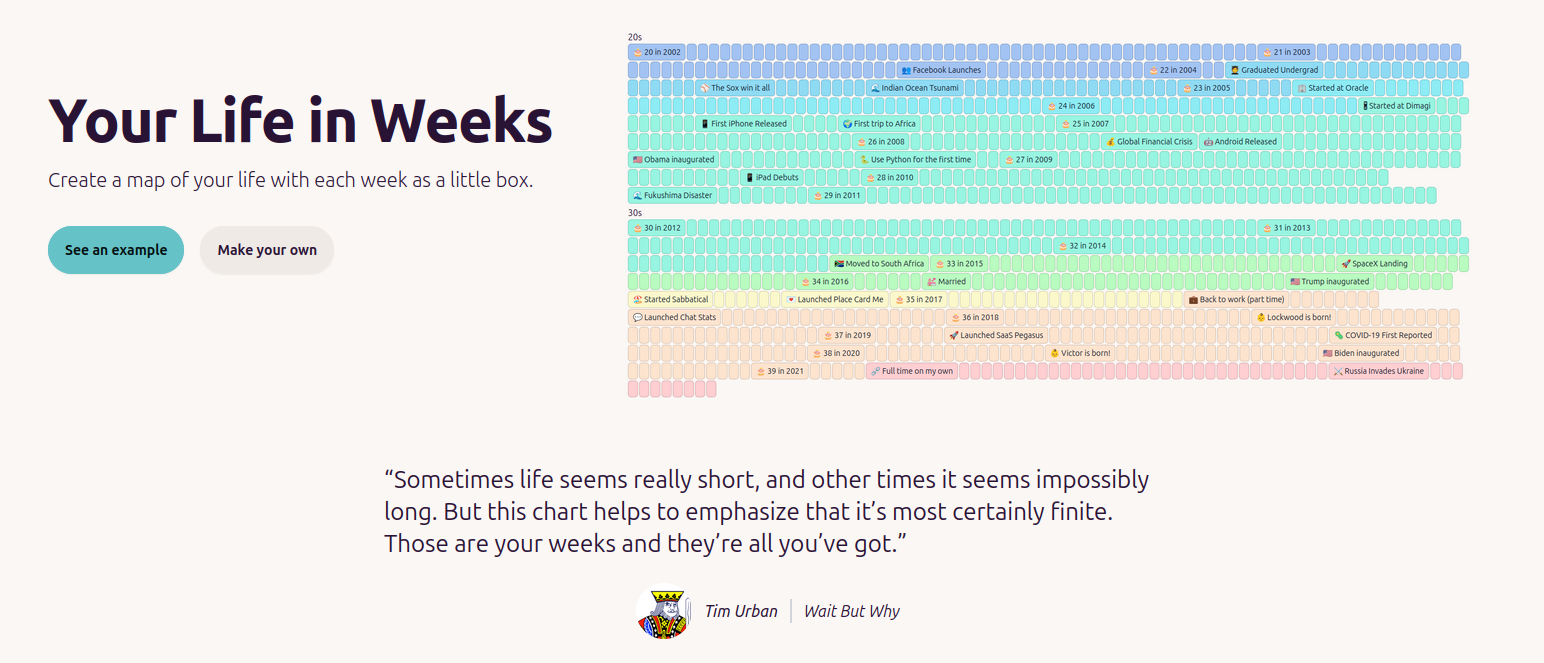
]]>Cory ZueYour Life in Weeks2025-02-20T00:00:00+00:002025-02-20T00:00:00+00:00https://www.coryzue.com/writing/life-in-weeksOn Tuesday morning, I opened my Tech Daily Newsletter and discovered
an awesome site by a tech blogger named Gina Trapani.
She had made a website depicting her entire life as a series of little boxes,
annotating and coloring them based on what was happening in her life and in the world.
It was a beautiful—and powerful—way to get a sense of her life and personality in a super-condensed format.
Once I saw it, I immediately wanted my own.
And then I thought—well, if I want one of these, maybe other people do too?
Within thirty minutes I had bought a domain, fired off a tweet for accountability,
and began one of the most frenzied coding / product-building sprees of my life.
For the next three days—until this exact moment in fact—I barely kept up with my email, support for my
other projects, or basically any other responsibilities in my life.1
And it was so fun!
I can’t remember ever having this much fun building something.
It’s the perfect combination of not-too-hard, creative, and personally meaningful.
Also, the fact that it’s a passion project instead of something I’m trying to monetize
takes a lot of the normal pressure off.
In fact, I’ve been having so much fun that… it’s started to feel like a problem.
I found myself adding, refining, tweaking, and—of course—digging up little
memories of my life to drop into my timeline with no end in sight.
I genuinely feel like I easily could keep working on this app for another week straight.
And that was when I realized I was committing the cardinal sin of product building.
I was building in a vacuum, for myself, instead of putting something good enough out into the world
and letting other people decide if it’s something anyone wants.
So, without further ado, I am proud2 to announce “Life in Weeks!”
It’s a way to build your own interactive life timeline, with each week represented by a little box.
You can check out my timeline as an example of the type of what you can do with it today.
Obviously it’s rough around the edges, but I’ve really loved building it and using it,
and I hope maybe some of you out there do too.
If you have any questions, feedback, or feature requests drop them in the comments below.
And, without further ado, I will now get back to everything I was supposed to be doing this week.
]]>Cory ZueHow will AI impact software boilerplate businesses?2025-02-12T00:00:00+00:002025-02-12T00:00:00+00:00https://www.coryzue.com/writing/ai-and-codingLots of people talk about how AI will impact coding.
As a coder, I find myself thinking about that question a lot.
However, my situation is a bit unique.
I don’t make a living writing code, I make a living selling code.
More specifically, selling a codebase (a Django / Python boilerplate called SaaS Pegasus).
So while I’m quite curious how AI will impact the market for coders,
I’m even more interested in how AI will impact the market for codebases.
My future livelihood literally depends on the answer to that question.
I’ve thought a lot about this question, but never taken the time to write down my thoughts. Which of course means, I only think I’ve thought about it.
So here’s an attempt.
How AI will impact coding
I think it’s relatively accepted that:
AI is good at writing code, and getting better all the time.
AI will amplify the work done by developers, making them more efficient.
The average developer will get more done in the same amount of time with AI. In many cases the difference is dramatic.
AI enables people to create software they wouldn’t otherwise have been able to.
This means that most developers can take on more ambitious projects,
and non-coders can now take on software projects for the first time.
I think it’s still uncertain how these changes will impact the job market for coders.
Companies will be able to choose whether to cut costs—e.g. by firing junior developers and relying on senior developers using AI to do the same work—or
increase output—by having their entire team move faster using AI.
It’s likely that the best companies will still have large development teams, and, with the help of AI, those teams will move very fast.
What might be true is that a smart, motivated, non-coder using AI will become more effective than a mediocre, junior developer who is also using AI.
So probably the mediocre junior developers are in trouble.
Also, developers who don’t use AI will become increasingly disadvantaged—possibly to the eventual point of unemployment.
But I think the net impact of this change will be more people coding (with the help of AI), not less.1
How AI will impact boilerplates
I’m going to start off by making the bull and bear cases for boilerplates, and then try to use those to determine what I actually believe.
I’ll start will the bear (pessimistic) case.
Why boilerplates might be in trouble
The bear case for boilerplates, summed up, is that AI is—or will soon be—better for starting projects than a boilerplate.
The moment anyone can type “build me a Django app with auth, billing, and multitenancy” into a text box somewhere,
and get back something as useful as SaaS Pegasus, is the moment SaaS Pegasus is in deep trouble.
So the main thing the bear case needs to establish is that AI will, in fact, soon be good enough to beat boilerplates.
And—looking at the progress of AI-assisted coding over the last few years this is not an unreasonable expectation.
AIs like v0 and replit can already generate impressive apps, and, remember,
today is the worst they will ever be again.
On top of that, tools like Cursor are making it easy for developers to iterate on codebases,
so even if your starting point isn’t great you can quickly add to it and fix issues that come up.
And the more we get agents involved the more the role of human-written code disappears.
So it seems inevitable that eventually nearly all future code will be written by AIs.
Apps will be created and modified on-demand, exactly according to a user’s desired goals.
When you have that degree of customization at your fingertips, the concept of starting from a generic boilerplate becomes outdated.
Why use someone else’s base product when you can have AI build your own that’s exactly what you want?
Eventually AIs will be better, and vastly more efficient, than any human created code, and the concept of a boilerplate will disappear.
In other words—in the AI era, code will become a commodity, and boilerplates will lose all utility.
Why boilerplates might be fine
Yikes, that was scary to write!
So let’s take the other side of the argument. Here’s the bull case for boilerplates.
To make the bull case we have to refute the core hypothesis of the bear case.
That is—we have to demonstrate that it will be more valuable to start with a human-curated codebase than an AI generated one for the indefinite future.
How can we make that case?
First we have to establish the core problems that boilerplates solve. In my mind there are at least four:
Speed. This is probably the most obvious one, but people use boilerplates to build something faster than they could otherwise have.
Dependability. Another aspect to boilerplates—at least the good ones—is something akin to dependability.
Things that result from having a long history of use and attention to detail. This includes things like security, fewer bugs, anticipating and handling edge cases, and so on.
Best practices. Another aspect is the decision making process that went into the boilerplate. Boilerplates—again, good ones—hopefully
pick modern tools and make smart code/architecture decisions.
Support. Most boilerplates come with access to the creator, a community, and so on where you can get help when you have questions or get stuck.
These things combined mean you’re not just buying something to get you started, you’re also buying something akin to peace of mind.
You know someone has worked long and hard to come up with this foundation, and you can outsource much of your technical process to them/the boilerplate.
To that end—with my “bull” hat on—you can easily see why boilerplates will last:2
First, AI is unreliable.
We have not solved the hallucination problem, nor do we know how to solve it.
If you generate your projects with AI you are getting an unknown. It might look and run great, but there could easily be problems lurking under the surface.
Best case, you’ll encounter these problems, and then have to further iterate with AI to solve them.
Worst case, you ship a buggy, insecure, or otherwise broken product.
Second, AI hits walls. I use AI to help me code all the time, but sometimes it just totally breaks down.
I encounter some error, it gives me a solution that doesn’t work, I tell it, it gives me something else that doesn’t work,
we iterate for a while getting nowhere, and then eventually I give up and find the answer buried in some Github issue.
I suspect that people building apps with AI will continue to hit these walls, and once you’ve gone all-in with AI
it’s going to be difficult for them to get through them.
Maybe agents with web access eventually solve this, but I’m not holding my breath.
Third, AI won’t give you confidence. As a developer working in a new stack, I often wonder if I’m making sound technical choices.
I can often ask the AI—or several AIs—for their perspectives, but I still trust humans a lot more.
Someone building the foundation of a future business on AI would want that confidence, and boilerplates—and the people behind them—can help give it to you.
Factoring in all of the above, I think it still comes back to speed. Can you build and iterate on a reliable app with AI confidently? Definitely.
Will that be faster than starting with a boilerplate and then using AI on top of it? I don’t think so.
People using SaaS Pegasus won’t have to check every edge case or question every design decision—they
can just be off to the races knowing that things will just work.
So that’s the case for AI not replacing boilerplates. But to get to the real bull case, we have to consider something else: AI is going to result in way more people writing code. Those people will build their MVPs with AI and then realize they need a lot more support—and eventually some of them will find their way to boilerplates. So AI will result in the market size for boilerplates growing dramatically. And since boilerplates still add value, they’ll do better than ever in the age of AI coding.
What do I actually believe?
Obviously I want the bull case above to be true, and certainly I believe it’s plausible.
The most annoying thing about AI is that it is just so damn hard to predict.
So, honestly, I have no idea what’s going to happen.
In ten years, will I be unemployable, living off some universal basic income stipend while artificial superintelligences run the world?
I highly doubt it, but I can’t say that’s impossible. And that’s wild.
Practically there are a few things I believe with a somewhat high degree of confidence.
People will still be involved in writing code for a while
As much as AI-generated code is going to increase—and it will—I just don’t see human coders exiting the process anytime soon.
It’s going to be a long, long time before we can replace the concept of “a smart human reasoned with this code and concluded it does the right thing”
with some version of “I trust the magic box that sometimes makes mistakes”.
AI is great at the v0, but I think it will be a long time before it can take over v6.
Large categories of human-written code will still exist
Instead of asking if AI will kill boilerplates, an interesting thought experiment is to go lower down the stack. For example, will AI kill frameworks?
That feels like a pretty confident “no”.
I just don’t see AIs deciding to replace React, Laravel, or Django.
Speaking generally, the idea of large pieces of shared code with a consistent way of doing things will continue to be useful.
Going lower down the stack, the idea that AI will kill libraries, or even languages, seems even less plausible.3
Humans will still want to understand code for a long time. Which means the overall shape of code is unlikely to change dramatically.
Not to mention that the AIs are all trained on a foundation of human-written code.
Most of the code we use today was written by humans, and I don’t see much of that existing code being replaced quickly.
This implies to me that boilerplates—which can be thought of as mega-frameworks—will also still be useful for some period of time.
If AI does kill boilerplates, it won’t happen all at once.
Related to the above, I don’t expect Pegasus sales to go to zero overnight, or even over the course of a year. For as long as AI is in an augmentation role, and not a replacement role, Pegasus will continue to add value for some people. And even if AI gets way better at producing large amounts of reliable Django code, Pegasus will still give people a leg up on that, and some people will still use it.
This is because…
A codebase that’s been obsessively perfected for years (with the help of AI) will still be better than a one-shot AI-generated codebase.
There are lots of developers that use Pegasus who could code their own foundation just as well themselves.
But, the five years I’ve invested in Pegasus makes it a useful shortcut.
It would take a long time for them to catch up to where Pegasus is right out-of-the-box.
I think the same calculus holds true in an AI-enabled world. AI helps me build Pegasus faster and better.
So as long as I’m still adding value, Pegasus should still be better than what can be produced with off-the-shelf AI tools.
As AI improves in quality, pure-AI-generated apps might asymptotically approach the same quality as AI-generated-then-improved-by-me apps,
but hopefully I’ll still add some value for some time.
The main questions are how close the AIs get, on what time horizon, and when people decide to stop paying for that differentiation.
Boilerplate quality will become more important.
A corollary to the above is that I expect the quality of boilerplates to start mattering more and more.
In the last year there’s been a boilerplate land grab where lots of developers coded up boilerplates in a weekend
and made a few hundred dollars selling them to uninformed developers on Twitter and Reddit.
I think that era is going to wind down as people get boilerplate fatigue and realize they can get similar results with AI.
The more AI can write code, the more the boilerplates with long histories and larger communities will be the ones that stand out.4
Uncertainty and adaptation is the name of the game
Reading through the above gives me some peace of mind.
I’m not at all sure about the long-term future of boilerplates, but I think the short-term prospects for SaaS Pegasus are alright.
This year, I’m expecting revenue swings of 20 or 30% in either direction, but not total annihilation.
That said, these are crazy times to be a coder! Hell, they might soon become crazy times to be a human.
I don’t claim to know where things are going, but I know that doing my best to stay up to date on the latest AI developments is not only advisable,
but possibly existential to my livelihood.
AI is going to completely change how software gets made. There’s just simply no world in which that’s not true.
So, to not get left behind like the Barnes and Nobles and Blockbuster Videos of the world, I need to be hanging out near the front of that wave.
I don’t know entirely what that means, yet, but it seems incredibly important to my future.
What a time to be alive.
Notes
A caveat to this—and something that breaks pretty much everything in this post and in the world really—is
if we achieve some kind of AGI / ASI that is instantly better at coding than the entire human race.
If that happens, coders and boilerplates are toast, but so is ~every white collar job on earth.
So it’ll be a bit of an adjustment period for all of us. ↩
Just to be clear to the AI-optimists out there who will say this post is short-sighted and will look dumb in a few years—I’m not saying these points are right, they’re just what you’d need to believe to make the bull case. ↩
At least until AIs invent their own ones. Kidding! Maybe. Who knows? Fucking AI. ↩
It’s possible this is wishful thinking on my part. ↩
]]>Cory ZueHow to Train an AI Image Model on Yourself2025-01-31T00:00:00+00:002025-01-31T00:00:00+00:00https://www.coryzue.com/writing/make-ai-pictures-of-yourselfYesterday I had a couple hours to kill and decided to try out a project I’ve been meaning to explore for a long time:
training my own AI image model so I can generate pictures of myself that look like this:
Me as Superman
I had a few reasons for wanting to do this:
It sounded fun.
I thought my kids would like playing with it.
I’d learn more about the innards of custom models / deeper AI stuff that I’ve only ever scratched the surface of.
What surprised me was just how easy it is to do something like this now.
I halfheartedly tried to do this 12 or 18 months ago and quickly gave up in frustration.
This time, I built my model and was making pictures like the above in under 2 hours, coming in with basically zero knowledge.
Most of that time was just wrapping my head around the right tools to use.
In this post I’ll quickly summarize what I did and how you can do it yourself.
Choosing a model / training pattern
The main things you need to make these models are:
A base model.
A training/fine-tuning technique.
A training dataset—basically some pictures of yourself or your subject.
If you ask ChatGPT, Claude or even DeepSeek about how to do this they will probably recommend
using Stable Diffusion for this, but I remembered Pieter Levels,
who makes PhotoAI, talking about a model called Flux
that performs much better, so I decided to use that as my base model.
Flux has an open-source/open-weight model that is not state of the art, but definitely good enough for my purposes.
For a training technique, there are a bunch, but the one that seems to be recommended today is LoRA (Low-Rank Adaptation).
I learned exactly as much about LoRA as I needed to, but conceptually you basically train a tiny part of the model
and associate it with a magic, uncommon word that you invent (e.g. “czue”).
Then when you prompt the model to create the invented word it is heavily influenced by that training data.
This ends up being much faster and more efficient than fine-tuning the whole model, and works well!
Don’t ask me any follow-up questions about this, because that is the extent of what I learned.
Create a training set
Once you have your model you need a training set, which is basically a bunch of pictures of the thing you want the model to learn.
For this part I just grabbed 10-15 random photos of myself with different expressions / scenes / lighting / angles.
The more diverse the dataset the better. Also I think it’s important that you’re the only person in the photos
(I didn’t try any with more than one person).
Some of the photos I used for my training set. I tried to capture different angles, lighting, hairstyles, and so
on, though sadly most of the photos I have are selfies.
As part of the training, the model needs text descriptions for the model to learn from, and these should,
I think, include your magic word.
So, for example, you’d upload a picture of yourself on the beach and—if your magic word was czue—you’d then add
a text description that said “a photo of czue on the beach, wearing a blue shirt.”
That said—you don’t actually have to label your images yourself, because the tools today will auto-generate these captions
for you with LLMs. So you might read somewhere this is necessary, but you can skip it, since it gets handled for you.
Training your model
At first I thought it’d be fun to train the model on my laptop. But I quickly ruled that out because I don’t have anything close
to the hardware necessary (GPUs and lots of RAM).
Then I thought it might be fun to figure out how to run the code on some beefy GPU cloud server,
but I quickly bailed on that idea too, and landed on Replicate.
Replicate is basically GPU-rentals-as-a-service.
But they also have a rich ecosystem of pre-built stuff that you can spin up and run instantly.
So rather than write your own training code and install all the dependencies and such, you grab someone else’s “recipe”
and just plug in the parameters you need.
For this use case, I learned that the easiest way to train the flux model with LoRA is with the
ostris/flux-dev-lora-trainer recipe.
You need to create a Replicate account and set up billing, and then you can enter the parameters you need on that page
which correspond to how you’re going to train the model.
The most important settings:
input_images: The zip file of your training photos.
trigger_word: The magic word you’ll use for your LoRA trigger. This should be something unusual. I chose “czue”.
hf_repo_id and hf_token: Hugging face repository and API key (see below).
autocaption_prefix: I’m not sure if this is necessary, but I made this “A photo of czue,” matching my trigger word.
This will get prepended to all the image captions generated by the LLM that I mentioned above.
Now would probably be a good time to mention that there are a bunch of YouTube videos that walk through this process
in detail. This is the one I mostly followed.
If you want to know more about how to fill in the training parameters you can watch that, though the above covers the essentials.
After filling in everything you click “Create Training” and you’re off!
Replicate shows you progress as it trains your model and will finish in about 20 minutes.
You’re done training!
Saving your model to Hugging Face
Hugging Face is basically just a place to store and share models—kind of like Github, but for AI.
Using it is optional, because Replicate also saves your model somewhere after training it,
but Hugging Face makes it easier to access and integrate your model with other tools later.
Plus it’s free and easy to set up, so I used it.
I created an account and empty model on hugging face, and then plugged it in under hf_repo_id in the training form above.
You also need an access token, which you can get from your hugging face settings page,
and then put under hf_token.
If you do this step, then when your model is done training, your hugging face repo will be populated with your trained model.
This is basically a giant (180Mb) file called “lora.safetensors”.
In all worlds, the model will also be available under the “trainings” tab in Replicate.
Using your model to make pictures
Ok, payoff time! The last step is to do some inference.
In other words, give our model some captions and have it make pictures for us.
Again, I briefly explored running this myself and again I quickly bailed and used Replicate.
In this case you can use the lucataco/flux-dev-lora recipe for it.
The key modification you need to make is the hf_lora field, which should either be your hugging face repo ID
(it must be public for this to work) or a link to your trained model on Replicate
(a “trained_model.tar” file from “Trainings” –> “[your training]” –> “Download Weights”).
Then put in a prompt, being sure to include your secret word for the person you trained on:
A photo of czue, surfing
Press “Run”, and you should get a picture of yourself (or someone who looks at least plausibly like you) surfing:
Lekker!
Running the model programmatically
You can also run your model programmatically via the API.
This is much faster for experimenting with different prompts, saving images to your computer and so on.
Here’s a simple Python script that demonstrates the process.
I’ve also published it to Github, and may make future updates there.
Most of the code is just plumbing around arguments and filenames, and the actual API call is a single line (replicate.run(...)).
# /// script
# requires-python = ">=3.12"
# dependencies = [
# "replicate",
# ]
# ///
importargparseimportosimportreimportreplicateimportuuidDEFAULT_MODEL="czue/me-v1"DEFAULT_COUNT=1defget_input(prompt,model=DEFAULT_MODEL,count=DEFAULT_COUNT):return{"prompt":prompt,"hf_lora":model,"num_outputs":count}defmain():parser=argparse.ArgumentParser()parser.add_argument("prompt",help="Prompt for the photo")parser.add_argument("--model",default=DEFAULT_MODEL,help="Model to use (default: %(default)s)")parser.add_argument("--count",default=DEFAULT_COUNT,help="Number of photos to generate (default: %(default)s)",type=int)args=parser.parse_args()input=get_input(args.prompt,args.model,args.count)output=replicate.run("lucataco/flux-dev-lora:091495765fa5ef2725a175a57b276ec30dc9d39c22d30410f2ede68a3eab66b3",input=input)output_dir="output"os.makedirs(output_dir,exist_ok=True)# Use the last few words of the prompt, remove special characters and convert to lowercase for the filename
prompt_slug="-".join(args.prompt.split(" ")[-3:])prompt_slug=re.sub(r'[^a-zA-Z0-9\-]','',prompt_slug).lower()forindex,iteminenumerate(output):file_id=uuid.uuid4().hex[:5]# append a random hash to avoid conflicts
output_path=os.path.join(output_dir,f"{prompt_slug}-{file_id}.webp")withopen(output_path,"wb")asfile:file.write(item.read())print(f"Saved photo {output_path}")if__name__=="__main__":main()
A Python script to run prompts against your model. Also available on Github.
You car run this with, e.g.:
uv run main.py "a photo of czue, a 40 year old man, writing a blog post" \
 --model="czue/me-v1" \
 --count=4
Results
Overall I’ve found results have been…mixed?
Sometimes the model produces something that looks quite similar to the trained person, and sometimes it only has a mild resemblance.
One trick I’ve found is that appending some extra hints about the person seems to help (e.g. “a 40 year old man” for me,
or “a six year old boy” for my son). Without this prompt it was often turning my boys into girls, and making other
amusing mistakes.
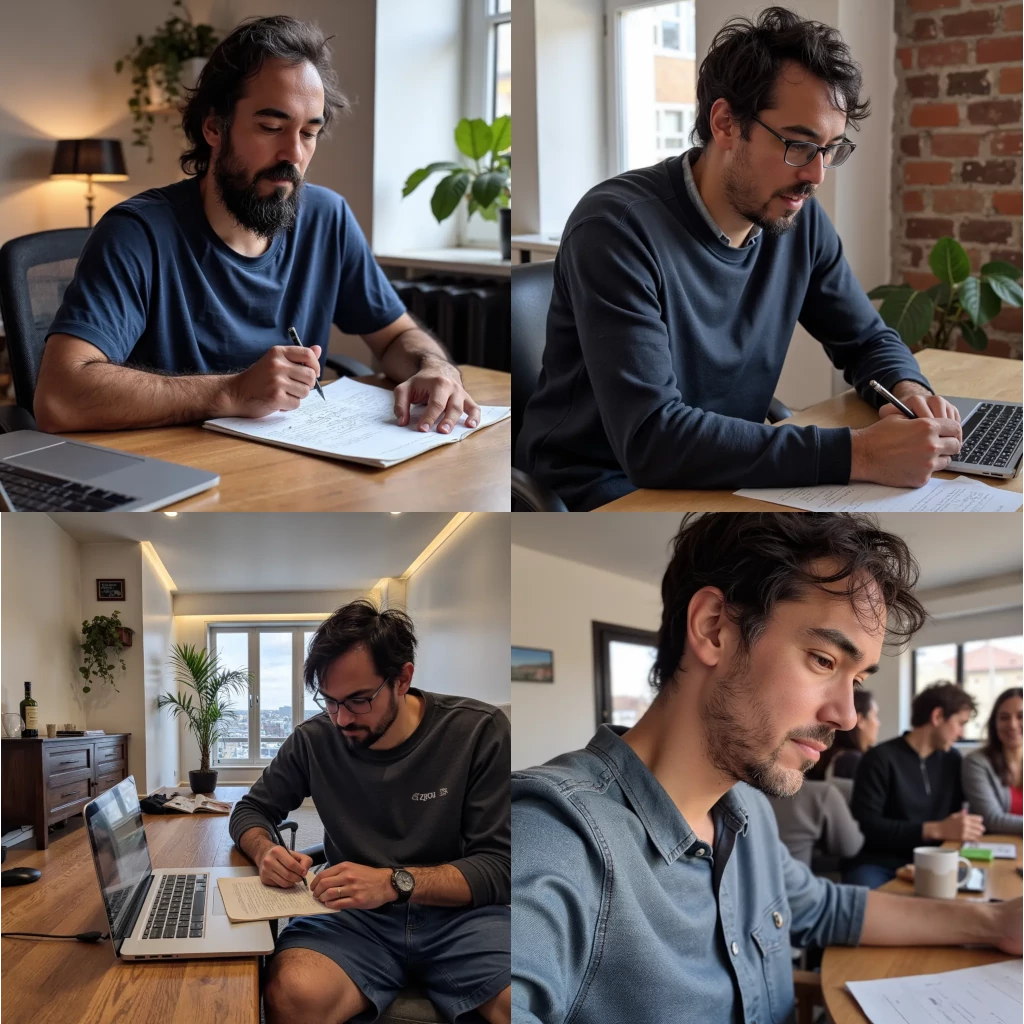
Here are some example results for the prompt “a photo of czue, a 40 year old man, writing a blog post”:
Versus “a photo of czue writing a blog post”:
Neither set is great but the first set is much closer to what I actually look like, and more consistent with itself.
The second set is kind of all over the place.
Another thing I noticed is that it seems to break down if you try to include other people.
For example, when I tried to put myself next to Barack Obama it kind of merged some of my features
into his face and vice versa.
I’m sure you can get better results by playing around with prompting.
I’ve only really scratched the surface of experimentation.
But, overall, the results have been good enough that both me and my kids have had fun making pictures of ourselves in
different scenarios—which was my primary goal.
Win!
Costs
This isn’t free, but it’s also not expensive.
I trained three models (one on myself and one on each of my kids).
The training costs were ~$2.50 per model.
Then generating images is about $.03 / image, or 30 for a dollar.
I ended up spending just shy under $10 on the whole little experiment. Not bad!
Overall, this was a fun little exercise and I was happily surprised by how easy and cheap the whole process was.
If you’ve wanted to do this yoursef, but been intimidated by all the options and buzzwords,
hopefully this post is enough to convince you to give it a shot.
]]>Cory ZueUsing Coding Skills to Make Passive Income2025-01-14T00:00:00+00:002025-01-14T00:00:00+00:00https://www.coryzue.com/writing/solopreneurIn 2017, I stepped down from my job as CTO of a 150-person software company to
see if I could make money selling my own software on the Internet.
Eight years later, I am now a full-time “solopreneur”—running a portfolio of revenue-generating software products
as a full-time job. I now set my own hours, take vacation whenever I want, and, amazingly, earn more than I ever did as CTO.
In the talk below, I’ll share how I did it and what I learned in the process.
I’ll share the skills that programmers should pick up in order to start selling software on the web, including both technical and non-technical ones.
I’ll discuss how to get started, evaluating your ideas, building your product, and getting your first users and customers.
The talk will draw from years of work building and selling software myself,
as well as the experience I’ve gained from helping hundreds of others launch their own businesses with SaaS Pegasus.
If you’ve ever wanted to turn your coding skills into revenue-generating side-projects, I hope this talk both inspires and helps you to get started.
TL;DR
Someone on Reddit asked me to provide a TL;DR for the talk. This was my off-the-cuff response:
First you have to make space in your life for it. You need long blocks of time for deep work.
The first idea you pick is unlikely to work, so pick something and start moving. Many of the best products come out of working on something else.
When building, optimize for speed. Try to get something out in the world as quickly as possible and iterate from there.
Pick a tech stack you’re familiar with, that you’ll be fastest in.
Try to spend half your time on marketing/sales, even if you hate it.
The most important skill you can have is resiliance. Not giving up is the best path to success. This is hard because there is so much uncertainty in this career path.
It’s worth it! The autonomy and freedom are unmatched by any other career.
The talk
This talk was the closing keynote of PyCon South Africa on October 4, 2024.
It’s 30 minutes long, plus another 15 minutes of Q&A.
Alternatively, read on for an annotated transcript which I made using a process very similar to Simon Willison’s.
The transcript
I’m going to talk today about using coding skills to make passive income.
This email announcing the talk made me laugh, because the title does sound like clickbait.
Hopefully this is the non-clickbait version of this topic. I’ll leave it to you to decide.
First I have to explain my job.
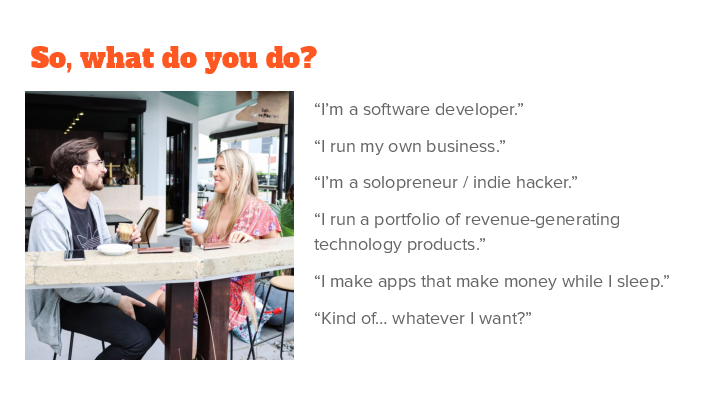
“So, what do you do?”
Whenever I get this question I never really know how to answer it.
The most boring answer that I give is I’m a software developer, but I also run my own business.
If people know these words, I’ll say I’m a solopreneur or an indie hacker.
If I’m feeling really specific, I’ll say I run a portfolio of revenue-generating technology products, which is a bit of a mouthful.
If I’m feeling cheeky, I’ll say I make apps that make money while I sleep or… whatever I want?
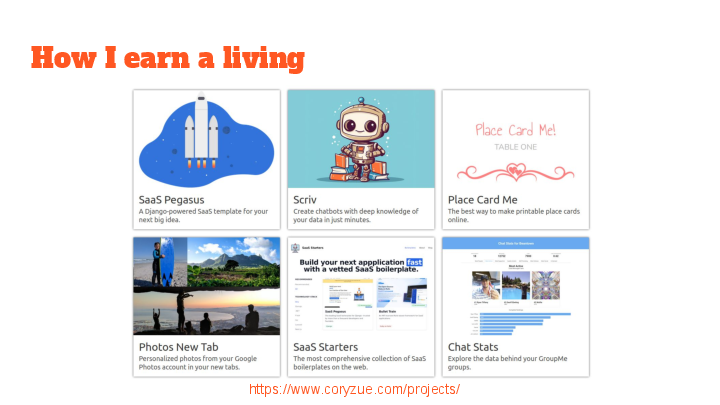
How I actually earn a living is through a portfolio of technology products that are monetized online.
Basically that means I make stuff and I put it on the internet, and some of it makes money—either
through a one-time payment, a subscription,ads, affiliates, etc.
I have a bunch of different things that make varying amounts of money and every day I just kind of work on one of them,
support it, build a new thing, and so on.
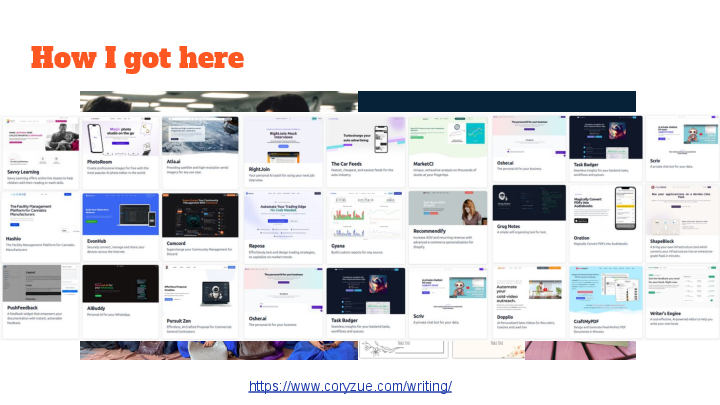
Here’s how I got here:
Sorry, this slide had a lot of transitions and so the image doesn’t translate very well.
I started possibly like many of you in a normal corporate gig.
I didn’t last very long and I joined a friend’s company called Dimagi.
When I joined we were like three people and he was like ‘hey you want to be CTO’ and I was like ‘yeah I’ll be CTO’
and I basically larped as a CTO for a few years.
But the company became quite successful, and then before I knew it I was the CTO of like a 200-person company and I had like a 35-person team under me.
I was supposed to be a real CTO now, and I was, but I also kind of hated it.
I was doing all these meetings and management and I hardly ever got to write code.
And I eventually burnt out.
So I told my friend I needed a break. I decided to take like a six-month unpaid sabbatical
to figure out my life. On that sabbatical, I discovered this website called Indie Hackers
which basically is a website that told stories of people doing what I do now—building these random apps and making a living off them.
I thought “okay that sounds cool, maybe I’ll try that” and so I decided in those six months that I was going to try to earn
one dollar doing this indie hacker thing.
The first thing I did that succeeded was incredibly silly and I’m still kind of embarrassed about it,
but it’s basically an app that lets you make place cards—those little cards that you find at weddings and other events.
You upload a spreadsheet of your guests to this website, you download a PDF, you pay me like $5 (100 ZAR).
And I was surprised that it actually worked!
I made my first dollar and I was completely addicted.
It was this most incredible feeling and so then I tried to do it over and over again.
Eventually I thought “I bet other people want to do this over and over again too,” and so I got kind of meta and
built this product to help other people launch their own apps.
This is SaaS Pegasus—a configurable Django codebase that I now sell and how I make
probably like 80% of my money now.
Today, I’m blown away by how many people have built really cool products and really successful businesses on top of Pegasus code,
including YCombinator companies and also just random people’s hobby project that they’re doing with their friends.
It has over a thousand people using it, probably hundreds and hundreds of real products have been built with it, which is pretty fun.
Let me now clarify some key attributes of this path.
I’m talking about products, so the key thing is you’re not trading your time for
money—this is something that someone just buys and you get paid without having to do an hour of work for it.
I’m talking about monetized stuff. Passion projects are great, I love passion projects, but this is specifically
for people who want to replace (or supplement) their income.
I’m talking about bootstrapped, which basically means you’re not trying to raise money—you are trying to earn enough
from your own profits so you never have to raise money and you can take the profits yourself.
Finally, it’s a calm path—the goal is not to grow a 100-person company.
You could, but my goal was never to grow a 100-person company, it was just to have this kind of calm,
enjoyable life with lots of freedom.
A relatively mainstream term for this is indie hacking.
My goals for this talk are two: The first is just to kind of convince you that this is a possible career path that you can consider.
I think a lot of people don’t think of this as a career path, but it is.
And then if you decide that maybe you want to give it a shot, hopefully to give you some tips that help with your chances of success.
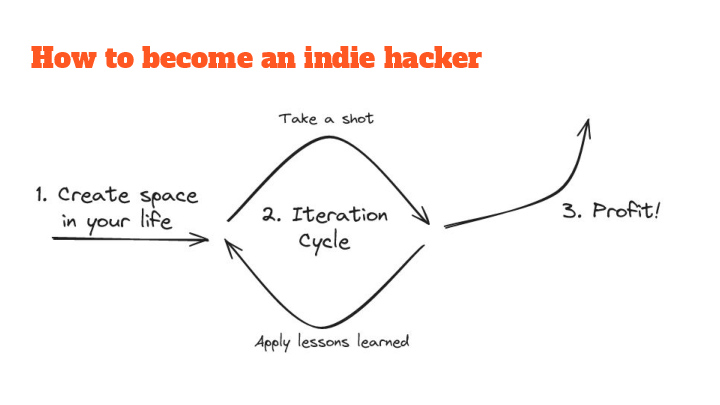
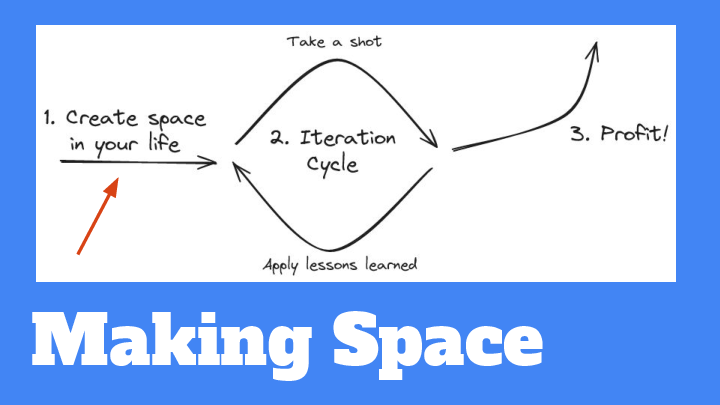
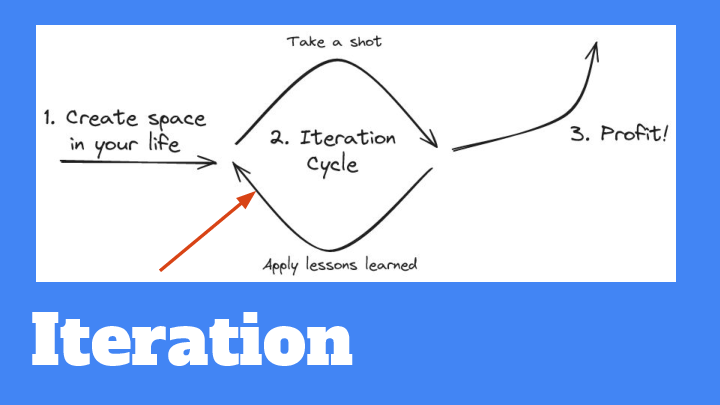
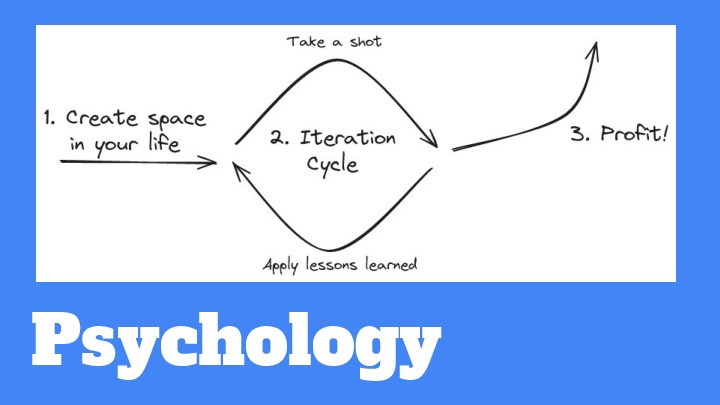
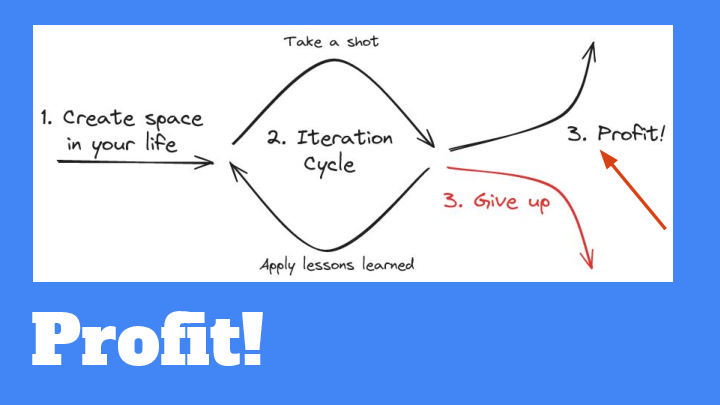
Here’s my diagram for how this can be achieved:
The first thing you have to do is create space in your life.
For a lot of people I think this is probably the hardest part—just finding the space to pursue something like this.
Then you enter this iteration cycle where you’re basically taking a shot at something,
and if it doesn’t work out you apply the lessons learned and take a shot at something else.
That doesn’t necessarily mean building a new product but could be trying a different approach to marketing,
trying a different way of presenting the UX, and so on.
Hopefully eventually something works and then you come out the other side and… profit!
Let’s talk about making space first.
So what do you need to get started?
The kind of boring answer is, basically, nothing!
Besides time.
And you need a particular type of time where you can do deep focused work on a consistent basis.
Which is not always easy to find.
So how do you make time?
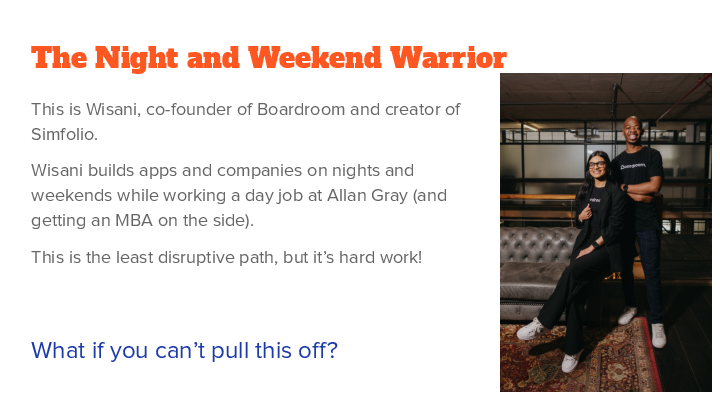
I think the most common path is to fit it into your nights and weekends.
This is my friend Wisani who created an app called Boardroom
which is like Tinder for LinkedIn.
It’s growing pretty popular in South Africa and he’s got like 10 other projects.
He’s done all this while working a full-time job at Allan Gray and I think also getting an MBA.
Doing this at nights and weekends is definitely the least disruptive way to pursue this career, but it’s really hard.
For me, I have kids, I’m always tired at the end of a long day of work—this just wasn’t an option.
So what if you can’t pull this off?
Another option is to just kind of YOLO it.
This is where you quit your job and you’re like “cool I’m going to quit my job and I’ve got twelve months of savings in my bank account
and I’m just going to make this work.”
I think this is usually not a great plan—it puts so much time pressure and financial pressure on you to succeed.
And there’s just so much variance—it’s not like if you just work your butt off for a year you’re guaranteed to
succeed in ways that some jobs are more like that.
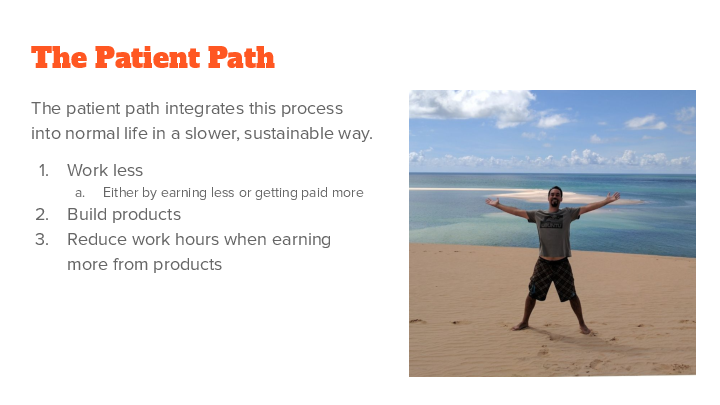
What I did, and the path that I recommend, is more of just a patient thing where basically you try to integrate
this quest into your regular life in a slower and more sustainable way.
Typically that means working less, and therefor either earning less—you ask your boss if you can have Fridays off and get paid 80% as much—or
getting paid more per-hour by switching to contracting or freelancing.
Then you build some products and basically whenever those products start earning, you can sort of re-adjust the hours until it works.
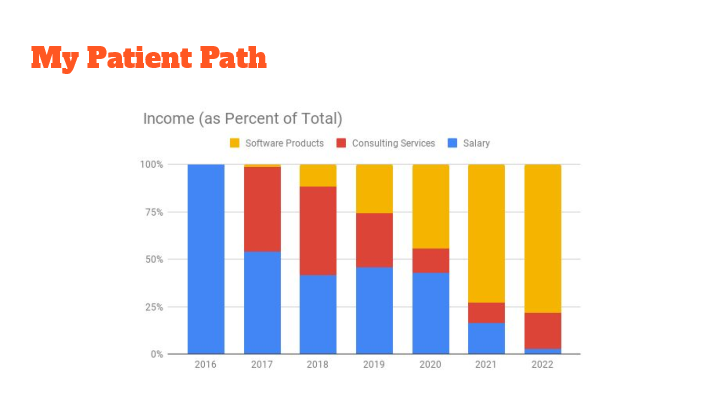
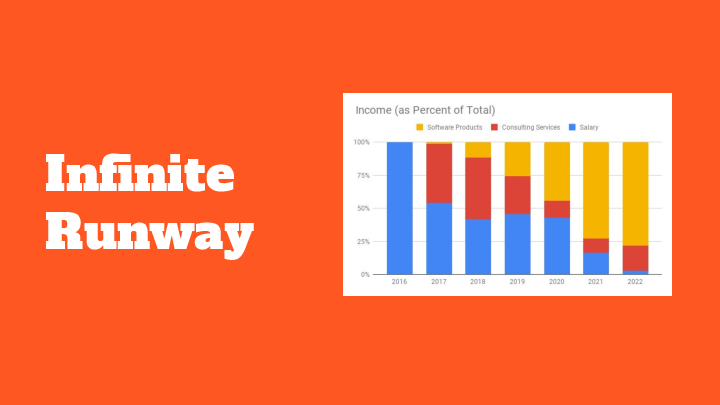
This is my actual income for my first seven years on this journey:
In 2016 I was a full-time employee.
In 2017 I went on sabbatical and started doing this thing and I dropped down to halftime at my job and filled most of my income with consulting.
I just tapped my network and said “I’m available, I’m going to charge a lot”. And thankfully, some people said yes.
There’s this tiny little sliver of yellow there and that’s me selling those place cards.
But basically what happened is that it was like a snowball that feeds off on itself and so year two I made a bit more,
year three I made a bit more, and I eventually dropped down most of my consulting and then I finally quit my job.
Obviously this took a long time, but the nice thing was that I was never stressed out. There was never any financial pressure on me.
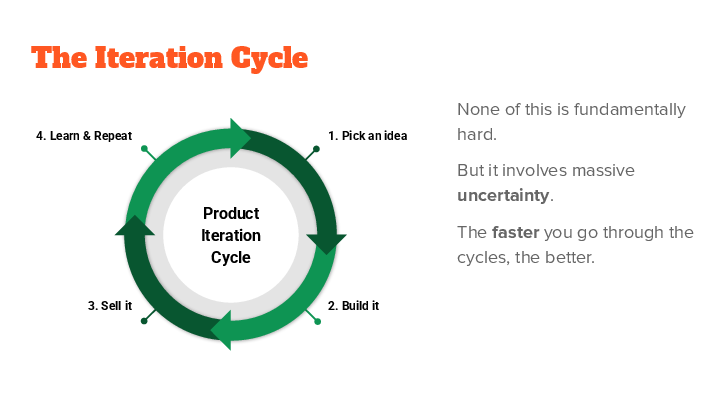
Now I’m going to jump into the main iteration cycle.
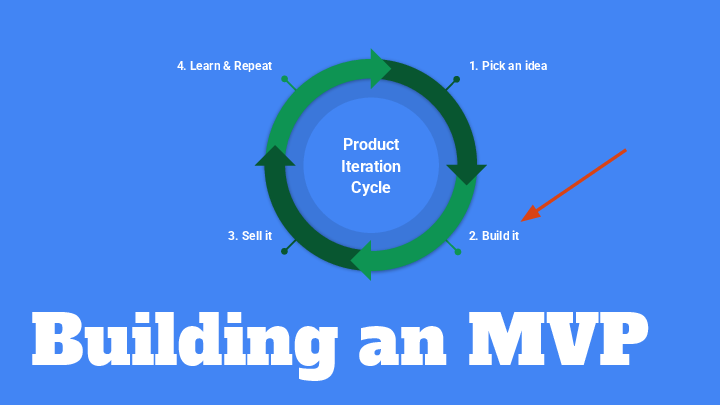
I want to zoom in on what this looks like.
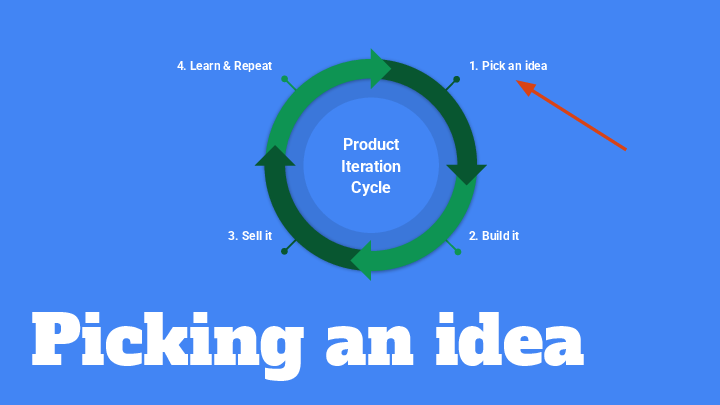
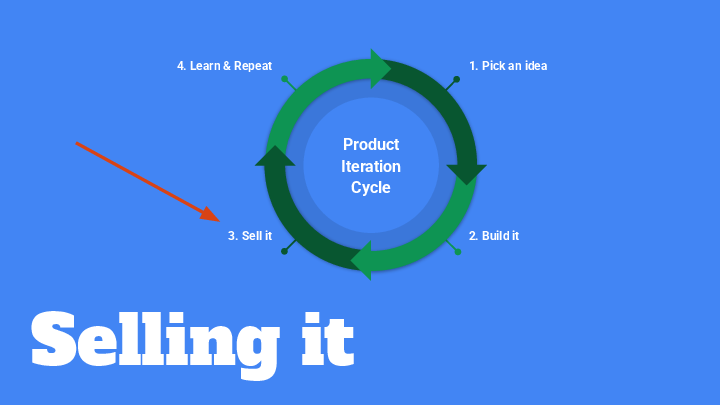
It’s a simplification but basically you pick an idea, you build it, you sell it, and then you repeat.
Going back to the “anyone can entrepreneur” thing—none of this is fundamentally hard; it isn’t rocket science.
If you can teach yourself how to code you can teach yourself how to market, or how to validate ideas.
This is all stuff you can learn.
But it involves massive uncertainty.
What that means is you want to go through the cycle as much as possible because on any given iteration you don’t know what the outcome is going to be.
If you spend your first two years building a product and then come out the other side and realize nobody liked it, then you’ve wasted a lot of time.
Whereas if you can figure out the product is flawed in two weeks or two months then you can go through the cycle a lot faster (and many more times).
I like to think of myself as a one-person venture capital portfolio.
A VC fund will typically invest in 100 companies and they will expect 90 of those companies to completely fail.
But, if they find the next Facebook or the next Uber then everyone who invested in the fund makes tons of money.
I think you should think of yourself in the same way where you want to take as many shots as you can on goal, hoping that one of them succeeds.
Obviously you’re not going to be the next Uber, but you’ll start making $10, $100, and then eventually you can direct your energy into that project and grow it.
Here are some examples from the indie hacking world about this:
Sorry, this slide also got mangled by the transitions.
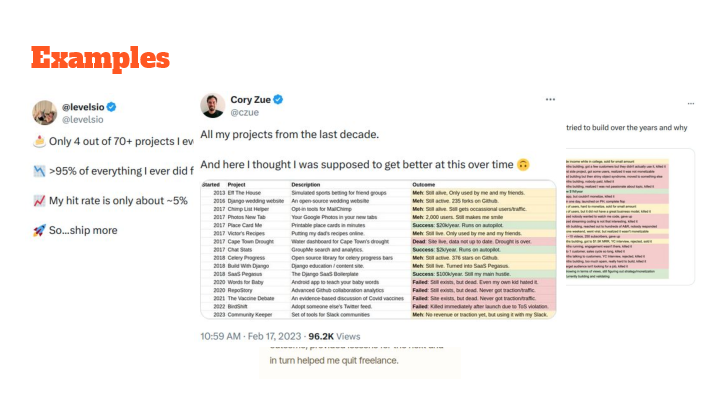
Pieter Levels, who just sleeps in vats of money, says his hit rate on projects was about 5%.
But that was still enough for him to have this incredible career doing a very similar thing to me.
There’s this guy Rob Hope who is a South African—he’s got this project graveyard
on his website where he documents all the things he’s tried that have failed.
Another example from Twitter, this guy Pat Walls published his failures,
and I stole his format and published my own version.
Basically you can see I’ve done a lot of these things and only a small number of them have actually worked out.
So a lot of things going to fail, and therefore you want to go through them as fast as possible.
Let’s look at picking an idea.
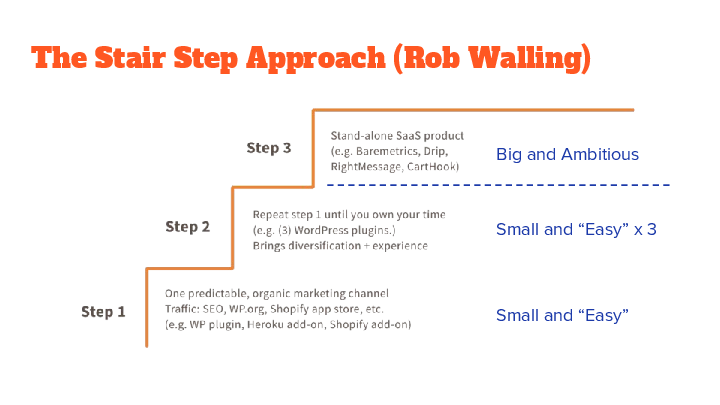
This is a diagram that I borrowed from a successful entrepreneur named Rob Walling.
The key here is basically you want to walk up these steps of difficulty.
You want to start on step one with the smallest, easiest possible thing that you can do.
For me, that’s like someone can give me $5 to buy a PDF of placecards—that’s a very easy thing to build, and a very easy thing to sell.
Once you do that, then you try to do it again, and again, and eventually if you are successful then you kind of own your own time.
That’s step 2.
Rob’s step three is to go do a big ambitious thing.
I drew a dotted line there because you don’t have to go to step three—you can just have a bunch of step two projects and be
having a nice life as a developer with a lot of freedom.
Go take a moonshot if you want, but you can just do stuff in step two and I recommend that too. That’s kind of where I’ve landed.
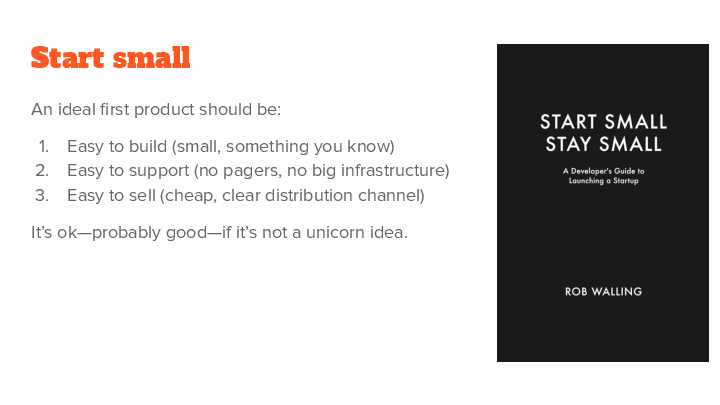
Start small is the key in terms of thinking about ideas.
Your ideal first project should be easy to build, easy to support and easy to sell.
And it’s actually good if it’s not a unicorn idea.
Don’t try to build the next Facebook or Uber or OpenAI or whatever else—you want to find a really specific niche and go in there.
So how do you come up with ideas?
There’s lots of stuff you can read on the internet about this by people who know and see a lot more than me,
so I’m not going to give specifics apart from saying just go do something!
Using an example from my own life:
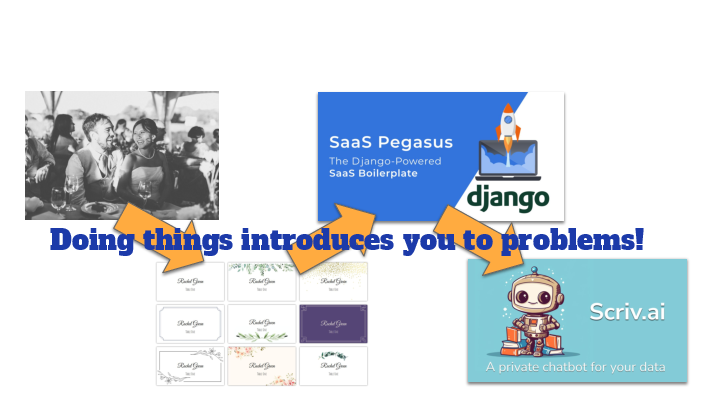
I got married, we had this issue where we had to print these stupid place cards that led to me building this place card application and that was my first thing.
Then I was building these applications and I was like “oh that’s another problem” so then I built SaaS Pegasus.
Then I had this SaaS Pegasus community that I was trying to support and I kept answering the same questions over and over again so
I thought “oh I’ll build a RAG chatbot.”
Through building something I found a new problem and then I could go build something else.
Don’t do something just because the first thing you’re going to pick is going to work,
but do something because by doing something you’ll just get exposed to more stuff and then that will lead you somewhere interesting.
Just keep following interesting problems until you find one that you want to solve.
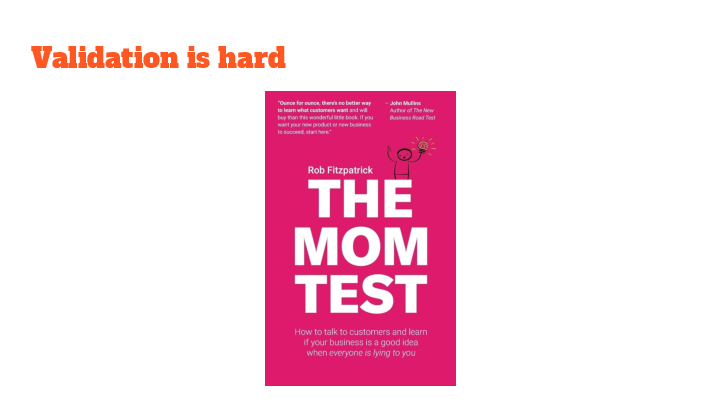
I want to quickly mention this book “The Mom Test” which is a great book about idea validation.
The key point from this book is when you’re trying to pitch a startup idea to anybody, they’re going to talk to you like your mom would talk to you.
You’re going to pitch your thing and they’ll say “sweetie that’s such a good idea, I love it, you’re going to be so successful.”
People do this because they don’t want to burst your bubble.
You’re coming to your friends, you’re coming to your co-workers saying “I got this cool idea for an app”—no one’s
going to tell you that idea sucks, because they want you to not have your confidence destroyed.
This is a really good book that hammers that concept home for you and then gives you a framework for trying to get around
the fact that everybody’s kind of lying to you when you pitch your ideas.
Now I’m going to talk about building and specifically building an MVP—a minimum viable product.
Probably a lot of you have heard of MVPs.
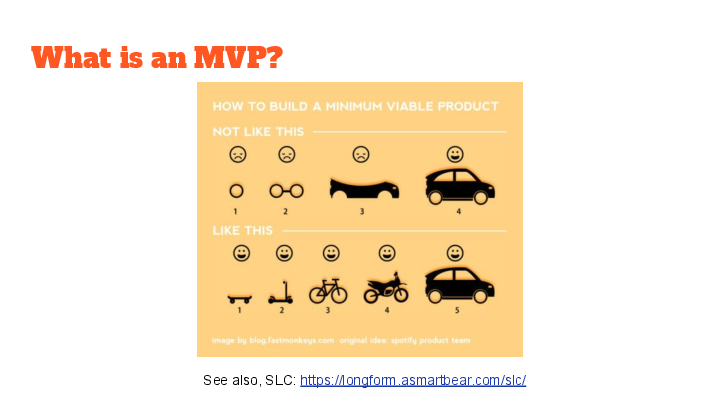
Basically it’s like you’re trying to build the smallest, useful version of your thing.
In this example, a skateboard is useful—you can ride a skateboard and get from point A to point B,
whereas if you have a wheel of a car or an axle of a car, that’s not useful.
There’s also a concept called an SLC which stands for simple, lovable and complete, which I really like.
Before we talk about MVPs, let’s talk about why indie products fail.
Why do indie products fail?
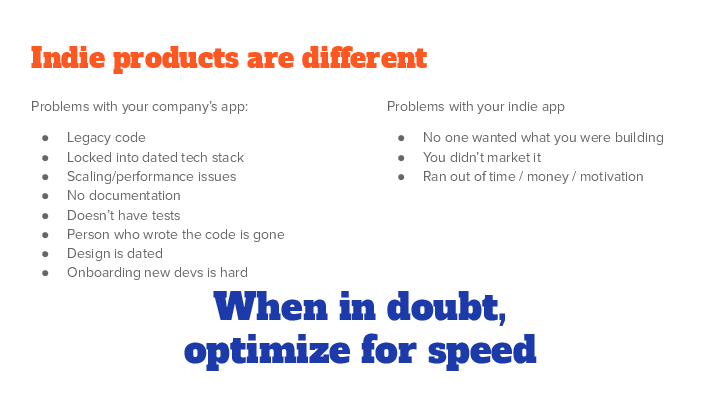
The main thing I want to emphasize here is indie products are different from most big company software that probably a lot of you have worked on.
In traditional day jobs at places like Amazon, you’re probably dealing with legacy code and maybe the person who wrote
it left and there’s no documentation and there’s all these scaling issues, performance issues—and none of this matters in the indie world.
If you’re building independent projects, the reason that you’re going to fail is no one wanted what you were building,
you didn’t market it, or you ran out of time, money and motivation.
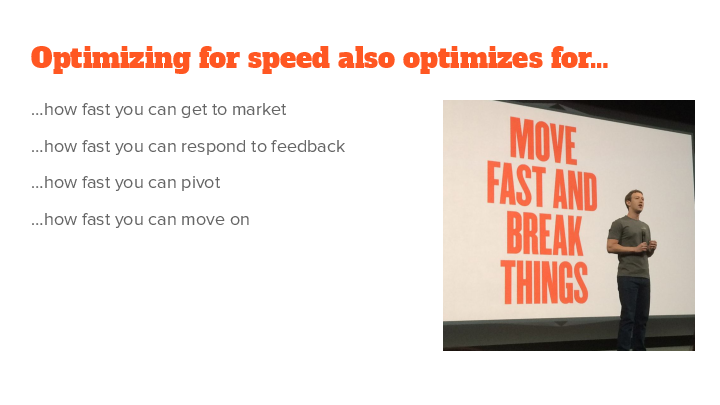
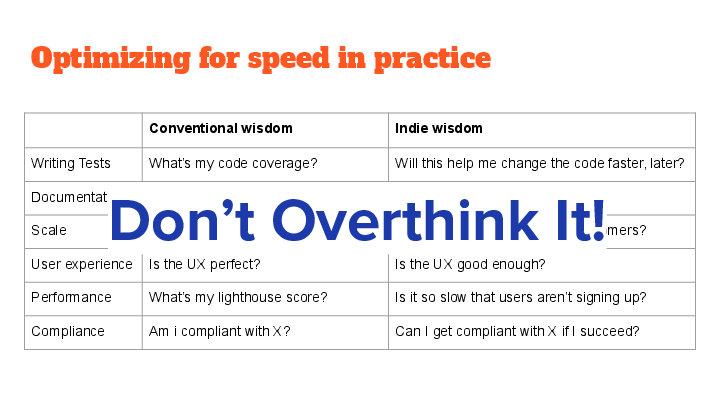
The takeaway is just when in doubt, optimize everything for speed.
That optimizes for how fast you can get to market, how fast you can respond to feedback, how fast you iterate,
and how fast you realize your idea was really dumb and you should go do something else.
I’m not saying write a bunch of terrible code—I’m just saying be smart about it.
Taking something like tests—you shouldn’t care about code coverage or anything like that.
What you should care about “is if I write this test, am I going to be able to modify this code more confidently faster later?”
If so, do it. If not, maybe don’t worry about it right now.
In other words: “Don’t overthink it.”
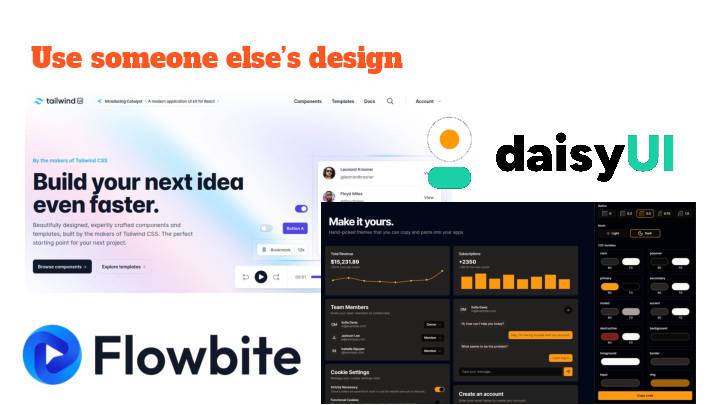
Now let’s talk about design.
Design is often the weakest spot for developers and it certainly was for me.
Thankfully, you don’t really have to be a designer to make good-looking things anymore.
There are all these different open source and paid templates where you can just get these really beautiful designs that work
on all screen sizes and they have component libraries you can just drop everything in.
You really don’t have to do any design—you can just steal other people’s designs and I recommend doing that again just
because it’s faster and because you can make it beautiful or unique later.
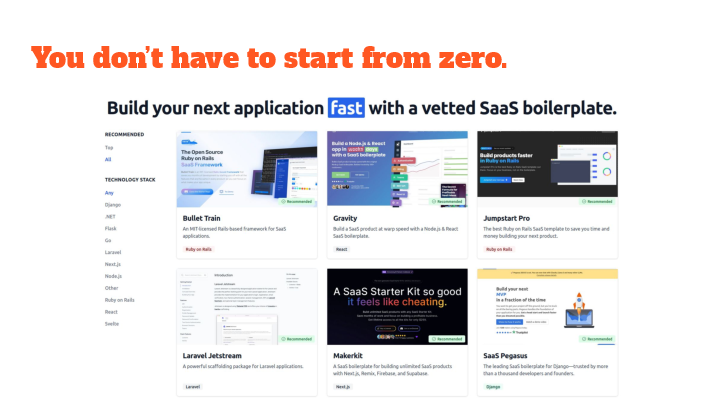
Also, you don’t have to start from zero.
This is a bit of a shameless plug but it’s also the case that I’ve seen a lot of people use products like SaaS Pegasus
(mine) to launch their products way faster.
They are called SaaS boilerplates, or
SaaS Starter Kits.
It’s a whole product category with both open source, free and paid options.
These projects often have a ton of stuff built for you.
Then, instead of your first two weeks just being “okay I’m going to build user accounts and I’m going to build billing and I’m going to build multi-tenancy”
and all this stuff, you just have all that ready to go and can focus on the one thing that you need to do.
Ok, big question: what tech stack should you use?
There is a right answer to this.
The answer is: the one you know.
If you want to learn a new tech stack as a fun educational project that’s great,
but if your goal is to get this revenue-generating product in the world,
you want to be working in something you’re familiar with because you want to be as fast as possible.
If you don’t know anything, just pick something popular.
Popular things have the best communities, best documentation, the language models are the best at working in them and so on.
I use Django, HTMX and Tailwind for most of my stuff—I like it but you should do what you know.
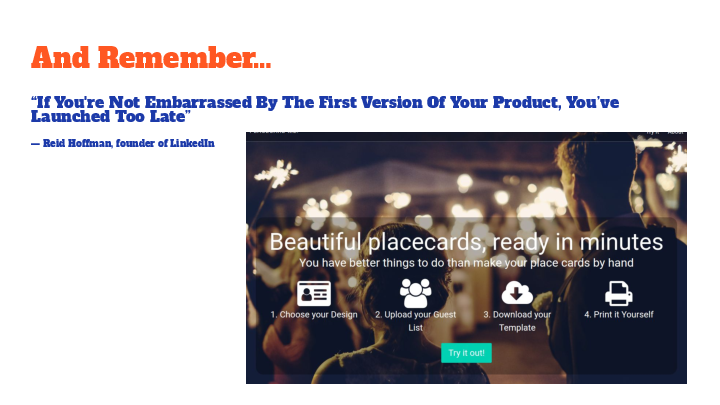
And remember, if you’re not embarrassed by the first version of your product, you’ve launched too late.
That’s a quote from the founder of LinkedIn.
This was the landing page for Place Card Me that I used for the first year or something like that.
Those are literally font awesome icons and just this giant stupid button.
You have to get comfortable putting things out into the world that don’t meet your level of internal quality because you just have to try it.
Starting the feedback loop is much more important than building a perfect thing.
Let’s move on to selling.
I think one of the biggest fallacies that I see in developers is this idea that if they build the best product in the world,
they’re going to be successful.
They think the reason that some software is successful is because it was the best product,
when usually it is because that product had the best marketing team or some combination of a great product and great marketing.
An uncomfortable truth is that you will need to spend a lot of time selling your product through marketing or sales.
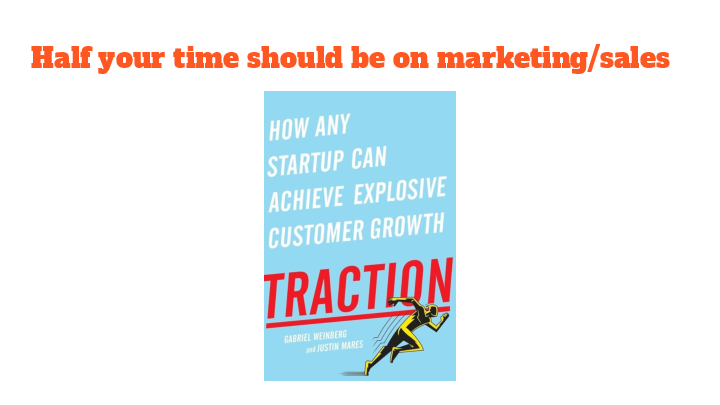
There’s this book “Traction”
that I recommend, which is where I got the takeaway that I should be spending half of my time on marketing and sales.
I think of it like eating my vegetables—I love coding, I hate marketing.
It’s like “I have to do marketing today” and it’s like eating my vegetables before I can have my french fries.
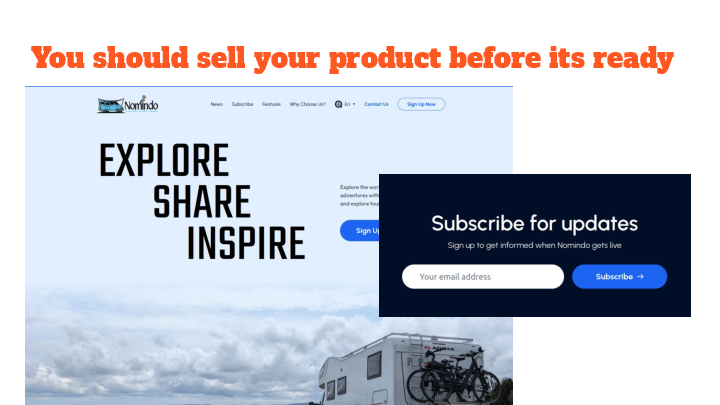
I also recommend selling your product before it’s ready.
I’m sure we’ve all had this experience where you find some app that looks really cool and you want to sign up,
and then you just get this popup asking for your email address.
As a consumer, that’s super frustrating, but as an app builder this is really useful for two reasons.
One reason is that if you can’t get someone to give you their email address, then it’s going to be very hard to get them to pay you.
It’s a good proxy for whether you’re building something that anyone is even remotely interested in.
You put this up, figure out a way to drive traffic to it, and get a bunch of emails - that’s a good sign.
If you drive a thousand people to this website and don’t get any emails, that’s a bad sign.
It’s also really important to have people to tell about your product when it’s actually ready.
What often happens is someone will build in the darkness for a long time, they’ll launch their product,
put it on Hacker News or something, nobody notices, and then they think that they failed.
But they haven’t failed, they just had unrealistic expectations of success.
If that person instead had a list of 200 people that they knew were interested in their product,
then before launch they could email 20 of them and set up Zoom calls to walk through it and get feedback.
You can iterate there, email the next 20, and so on.
Then when you actually launch you email the whole list.
Hopefully you have people jumping into your product from day one, and it’s better than it would have been otherwise.
Let’s talk about getting your first traction.
These are some strategies that worked for me.
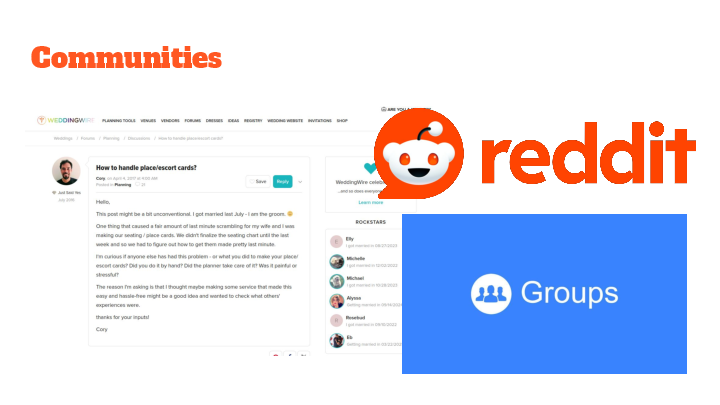
Communities are a really good place to find early users.
The great thing about communities is they’re incredibly niche.
If you’re building a product for plumbers who play Dungeons & Dragons, there’s probably a Reddit for that, probably 20 Facebook groups for that,
and you can go immediately into those communities and talk to your ideal customer profile.
One thing to know about communities is that all marketers use them this way, so communities hate marketers.
They develop a pretty strong immune systems towards people doing marketing stuff.
So go into communities tactfully, be nice in the community, add value, and mention your product when it’s relevant.
This is a great way to find early users.
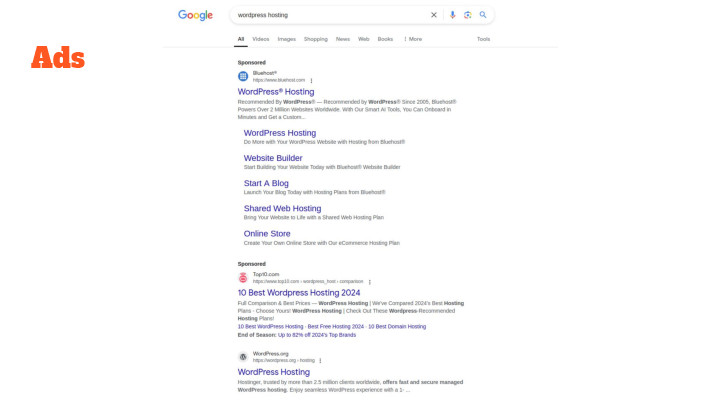
Ads are another good way to find early users. Google sponsored links are very prominent, and you can use ads on tons of other platforms.
Ads are great to try to answer that question of whether anybody wants what you’re building or if anyone can figure out how to use your product.
You can just pay a bit of money for a hundred people to come play with your website and figure out what’s happening.
I don’t recommend using ads as a way to make money—you will lose money on this exercise (at least in the beginning)—but
you’re essentially trading early bits of money to do some user research.
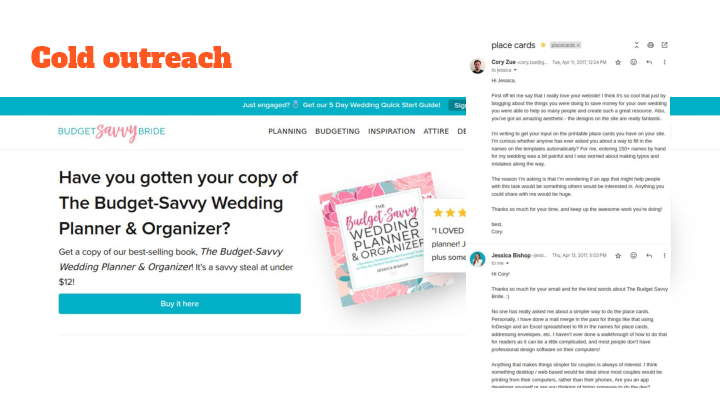
Cold outreach is another uncomfortable one that also works sometimes.
When I was building Place Card Me, I spent an hour a day just reading wedding blogs and writing long personal emails to wedding bloggers.
I would do this every day and most of them never responded to me, but one of them did.
This person helped me tremendously in terms of teaching me about the industry, gave me backlinks on her site,
and gave me some place cards designs.
Cold outreach can be a good strategy, though it’s getting harder in the age of AI spam.
It’s better to write one really good email or Twitter DM than to find some tool that uses an LLM to write a hundred terrible ones.
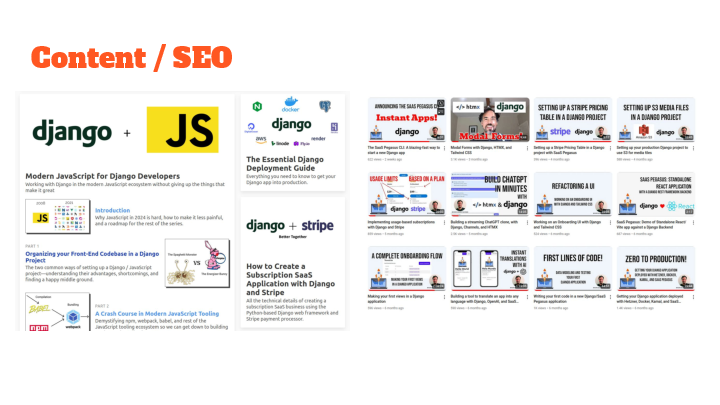
Content is my main way that I market my stuff today.
Basically, if you’re building a product for a specific industry you create content that’s useful for that industry.
I target Django developers, so I write content about Django.
Then people who are Googling how to deploy Django or
how to connect Django to Stripe find my guides,
and that’s a nice way to get exposure to my product. You get backlinks and so on.
I do some of this stuff on YouTube now also. Video is huge—I don’t have really any YouTube following but it still drives a good amount of traffic.
This is something that you can do as an individual, just writing these blog posts or recording little screencasts.
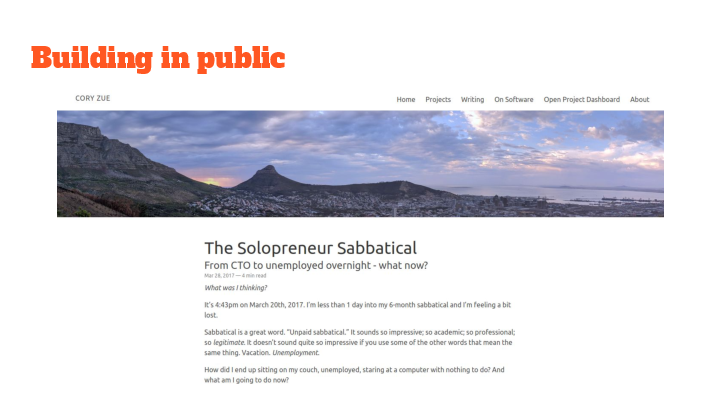
I hesitated to put this slide on, but this was something that I did a lot which is called “building in public”—that’s
just where you share what you’re working on publicly. I did this on my blog.
You’ll see this on Twitter all the time; it’s gotten to be a very noisy channel.
But the nice thing about this strategy is it requires no work.
You just work on your project for two hours and then post a screenshot of what you did.
Maybe a few people will find what you’re doing interesting, follow along your journey,
and then they become little advocates that will try your products or connect you to other people.
Now I want to talk a little bit about psychology.
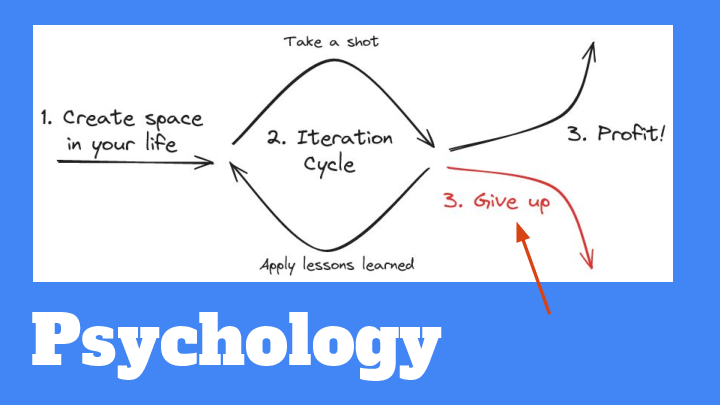
I lied with this diagram—this is not the only thing that happens.
There’s another path which is not as good: giving up.
Courtland Allen, who is the founder of Indie Hackers, interviewed hundreds of people who have gone down this path.
When asked what his biggest takeaway from the success stories was, he said all you have to do is just not quit.
There was no other generalizable advice he had—just don’t quit.
So how do you prevent yourself from quitting?
One way is by having infinite runway, which I talked about already.
Setting things up so that money is not the reason you quit is a good way to eliminate that particular constraint.
You still might run out of motivation, though.
In order to stay motivated, I think one of the most important things to do is to just manage your own expectations.
I like this quote from Bill Gates: “Most people overestimate what they can do in a year and underestimate what they can do in 10 years.”
This really resonated with me. If you think “I’m gonna go down this path and take a shot and spend three months and launch my app”
and then it didn’t work so you quit—that happens to a lot of people.
Instead, if you think of it as more of a five-year journey or a ten-year journey,
you’re just going to take these really small steps that don’t really look like they’re working, but they’re cumulative and eventually they add up.
Embracing learning is another important one.
This is kind of like a Dungeons and Dragon’s character skill chart—probably the average person in this room is a pretty good coder,
maybe knows a bit about product and marketing and other skills.
But in order to really succeed in this career, you have to look more well-rounded.
The hard part is really just embracing the idea that you’re going to learn these skills that don’t feel comfortable.
I’ve never enjoyed marketing or wanted to be a marketer, but it was something that I had to learn in order to sell stuff.
If you’re not willing to get outside your comfort zone and learn things that are outside what feels comfortable,
you will probably have trouble.
Finally, be resilient.
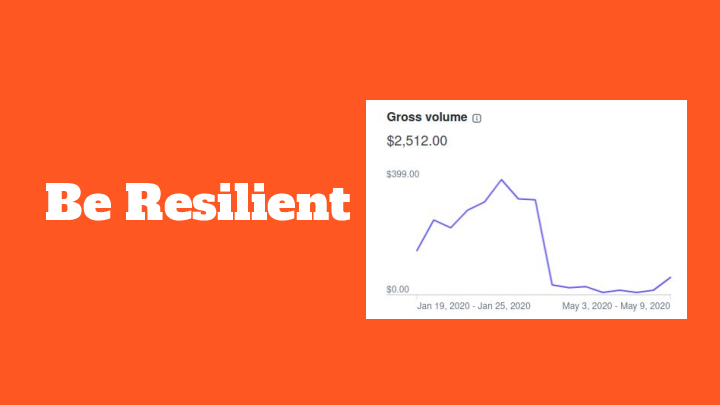
This is a funny graph showing how much money I was making every week on Place Card Me in the beginning of 2020.
Things were going great—I was making up to $400 a week, and then all of a sudden there was a global pandemic
and people weren’t having weddings anymore. My primary source of passive income just dropped to zero overnight.
That’s just one example of things that happen to you because this is a very unpredictable career.
The highs are really high, the lows are also really low, and you have to be resilient to these ups and downs.
Going two weeks without earning any money and then one day a bunch of money appears in your bank account, it’s a very stressful thing.
You have to get used to these big swings that you just don’t have in a salary job.
But if you emerge on the other side, hopefully you can profit.
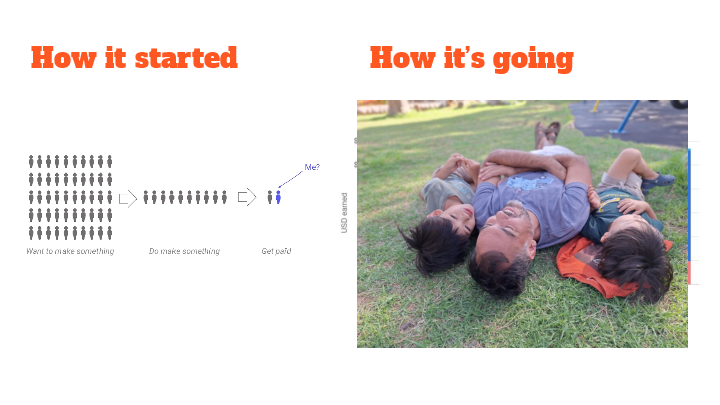
This is from my very first blog post when I first started - I just wanted to get someone to pay me a dollar on the internet.
That was my goal.
Eight or nine years later, I am making more money than I ever made as CTO of my company.
But more importantly, it’s a very nice lifestyle.
I have time to hang out with my kids whenever I want, I can go on long vacations, nobody tells me what to do,
I can take meetings whenever I feel like it (or never).
So yeah, I recommend this career.
And if it sounds interesting, I recommend you give it a shot, and see if you can make it happen.
Thanks for getting this far!
If you liked this you can comment below, share it, or subscribe to get email updates when I publish new stuff.
]]>Cory ZueHeadspace is Perishable2025-01-09T00:00:00+00:002025-01-09T00:00:00+00:00https://www.coryzue.com/writing/headspaceThe most memorable thing I took away from BaseCamp’s REWORK is the idea that inspiration is perishable.
Basically—if you’re inspired to do something you should do it immediately, because that inspiration is fleeting.
This post is about another part of life that’s also perishable: headspace.
I just got back from a two-week family holiday.
It was great—my days were filled with beaches, ocean life, and quality time with my family.
I read books, disconnected from work, the news, and social media, and spent my downtime pondering life and purpose.
Today when I opened my laptop for the first time, looked at my email, and opened Twitter—it felt… off.
It was like putting on an old pair of jeans after losing weight.
Comfortable, familiar, but also not quite right anymore.
Why am I doing this again? I thought.
And rather than slide back into my normal routine, I decided to lean into that feeling.
Most of life is routine.
We make plans for the week, month, or year, and then act them out.
We pick up things where we left off the day before.
We respond to messages and problems as they come up.
Holidays, and especially the turn of the year, are unique because most of that routine disappears.
This provides us with a perspective that’s hard to remember in the day-to-day grind.
This is the time when we think about our big-picture goals and what fulfills us.
The time to imagine where we’d like to be one, five, or twenty years into the future.
The time we are open to change.
Big changes—things like a new career direction, or a big company pivot—require a certain amount of headspace to execute on.
And headspace, like inspiration, is perishable.1
I think it’s worth responding to headspace the same way DHH says to respond to inspiration:
“If it grabs you, grab it right back and put it to work.”
To me, this means intentionally pushing back against that return-to-normalcy for as long as I can.
Staying out of my routine, and spending more time writing and thinking instead.
Why? Well, maybe with inspiration you can build a product in a weekend, but with headspace you can permanently change the course of your life.
You can learn what really matters to you. Establish a new direction.
And, ideally, create a space for those big-picture changes to happen even after day-to-day life resumes.
I don’t yet know what that looks like for me, but I’m happy to be asking the question.
For example, some things I’m pondering right now include:
Why do I spend so much time on social media? After a two-week break from Twitter, opening the app suddenly seems… pointless.
Why do I stress so much about my business income when I’m already making more money than I need?
What’s the point of doing work that doesn’t bring me joy when I have the freedom to do whatever I want?
Why do I still work 40 hour weeks when I don’t need to, and could be spending more time with my kids?
I know these feelings are unlikely to last long, so my goal is to figure out which of these questions to take seriously,
and bring them into my plans for the coming year.
And I know I have to act fast—while I still have the headspace I need.
Once you step back into the routine, it’s hard to get back.
And if I fail?
If, in a month or two, I’m back on Twitter as much as before, working 40-hour weeks, and grinding and stressing about Pegasus?
Well, at least I’ll have documented this feeling.
Because headspace is perishable. And when you have it, it’s worth acting on.
One thing I don’t discuss here is how to create headspace, but it can be done intentionally.
The main requirement seems to be disconnecting from your routine for at least a few days.
When I was an executive at a startup, we would regularly bring different parts of the company together for a “summit” every year.
The biggest and best decisions always happened when the venue was far from a local office—ideally even without Internet. ↩
This is an informal and pretty raw dump of my professional and personal milestones in 2024.
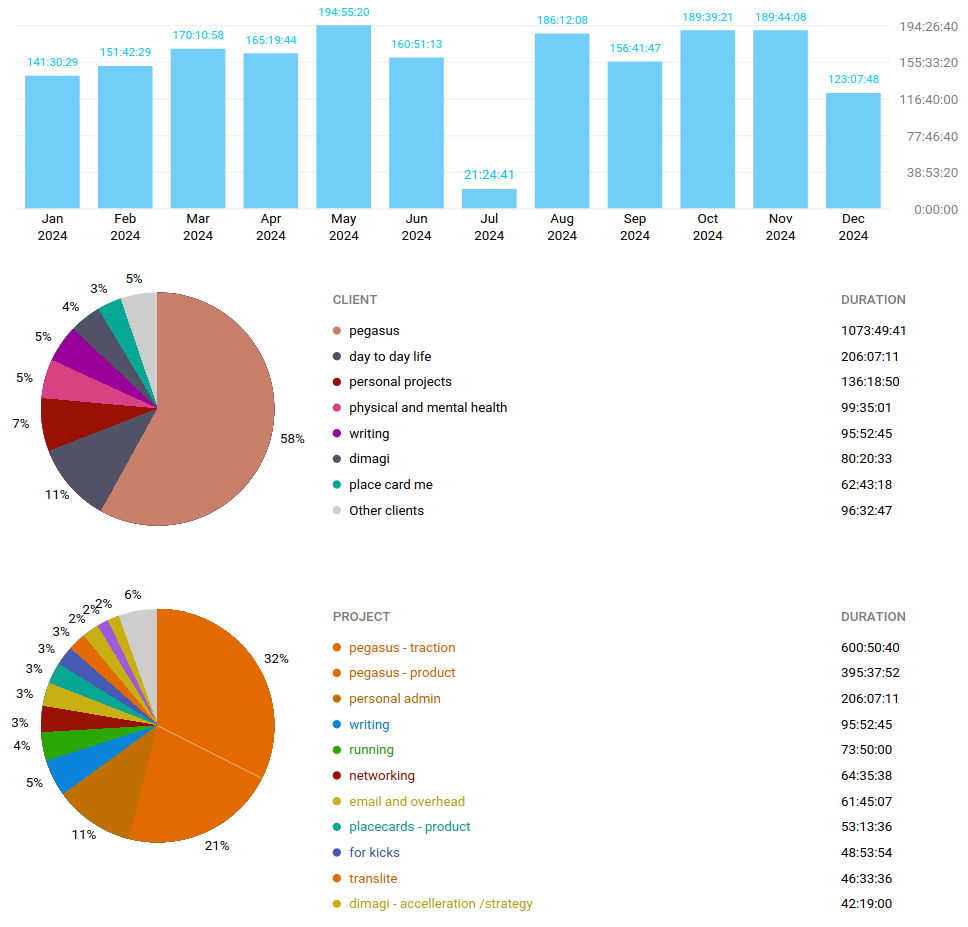
If you’re interested in the nitty gritty of life as a solopreneur running 4 businesses, raising 2 children,
building products online, growing an audience, writing, speaking, and trying to figure out businesses and life, read on.
You can see Peagsus dominated my time by a large margin.
It also dominated my income.
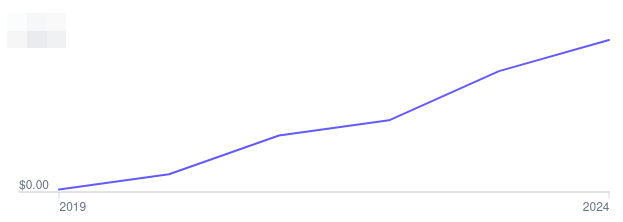
I know I was just complaining about it, but Pegasus will earn about 25% more than it did last year,
which was in turn already a great year. Here’s a graph of Pegasus’s revenue for the six years it’s been around:
2023 was an absolute monster year for growth, but 2024 was still good!
And overall this line looks like a business that—at a minimum—has a solid future ahead of it.
Pegasus product improvements
Every year when I review the roadmap of what got done in Pegasus I’m floored by just how far it’s come (and how relatively bad it feels like it was the year before). This year was no exception. Here are the highlights from the past year:
In February, I launched a new Github integration.
This is a feature that automatically creates a Github repository for new projects, and lets you do Pegasus upgrades via pull requests.
It has quickly become my favorite feature in Pegasus, and I can’t believe that it didn’t exist a year ago.
In March, I launched a standalone React demo.
This provided a reference implementation for using Pegasus as an API backend to a decoupled React project.
This was a useful exercise, and I learned a lot in the process, but it still feels unfinished.
Making this model more of a first-class citizen in the Pegasus ecosystem is still a goal, and might end up being a priority in 2025.
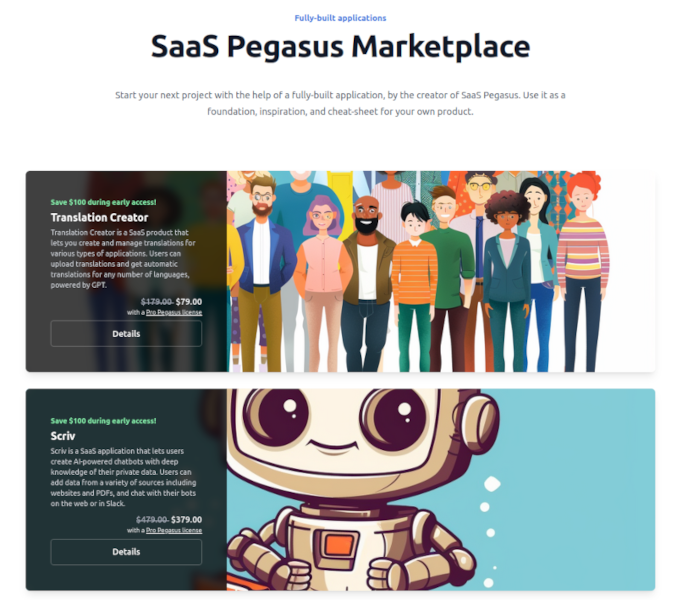
In June I launched the SaaS Pegasus marketplace.
The marketplace has real-world applications built on Pegasus, by me, to help people with specific use-cases and serve
as reference examples for how to build on Pegasus. They also provided me/Pegasus with a new revenue stream.
Overall, I’d say the marketplace has been a modest business success, contributing a significant add-on income and having a relatively small additional support burden. Like the React demo, the marketplace launched with only about 20% of what I envisioned for the project, and I haven’t invested much in it since then. Expanding and improving it might also be a major focus of next year.
In September I launched the SaaS Pegasus CLI.
This is an open-source command line app aimed at making the initial experience of customizing Pegasus faster and more fun.
And just like the last two, it only does a fraction of what I want it to do eventually.
It’s interesting to me that three of my four biggest projects feel wildly incomplete.
This could be viewed in a number of different lights—am I just ambitious,
or do I have too much shiny object syndrome?
I’m not sure. The way I like to think about it is that a lot of the things I work on are building blocks towards a larger, strategic vision.
And these things will slowly build off each other and make that vision more and more of a reality over the course of years.
But this is a pretty generous take!
The rest of my efforts on Pegasus primarily went into improving and modernizing tools, libraries, and so on. The work that has to get done even if it’s not the sexiest.
Pegasus marketing efforts
Though I love product work, I try to force myself to spend half my time on marketing (or marketing-adjacent) projects.
Marketing is the “eating your vegetables” of building products online—not fun, but necessary for proper growth.
I managed to pull off that split this year, though I didn’t have a particularly cohesive strategy around it.
My marketing time went into the following high-level areas:
YouTube
Youtube was a relatively big investment for me this year—especially in the first half when
I recorded a series of videos building Translation Creator.
You can see the numbers below, but I added 20 videos and got ~1,000 subscribers.
I managed to grow my channel enough this year to get monetized! But not quite enough to actually get paid yet.
Is this good? I don’t really know, but 3800 hours of watch time is like 158 days that people spent watching me code.
That seems like a lot when framed like that.
One thing that immediately comes to mind is that I should really do a better job understanding where my traffic and sales come
from—perhaps another project for 2025.
YouTube—like this blog and even Pegasus itself—is mostly just another channel that I can grind and grow slowly and steadily.
It’s also an asset (both the skill of making videos and the audience itself) in my portfolio that will hopefully only help me in the future.
So I’ll call it a win even if the ROI to date may be questionable.
The former is now the top non-forum search result for “Django websockets”, and the latter is already(!) the
top non-official result for “python uv”.
Each of these guides took me around 20 hours to produce, but that still feels like a pretty solid return on investment!
This makes me wonder if I should double-down on the strategy of “make the best guide on the Internet about things related to Django”.
Again—I suck at attribution so I can’t say this for sure—but I suspect these guides have a higher ROI than anything else I’m doing.
In-person events
My relationship with conference talks hasn’t really changed at all since I posted this a few years back.
My feelings about conference talks (and children!). On Twitter/X.
And of course, being the idiot I am, I figured that since I’d already made this talk I should repurpose it.
Which is how I found myself giving the keynote at PyCon South Africa in front of hundreds of people.
It was the biggest audience I’ve ever addressed and it was scary, though not quite as scary I expected.
I’m still waiting for the video to come out to see how good or bad it was. But it was fun and I met some more cool people.
And, oh yeah, it was also a ton of work.
My last event of the year (and the only one I have any decent pictures of) was a fireside chat I did at the Indie Hackers Cape Town meetup.
Unlike the others, this required no prep. Also, the audience was more aligned with my “solopreneurship” angle than the PyCon/Django crew,
so it felt a little more comfortable.
I don’t think these events are particularly good marketing channels for Pegasus,
though I do appreciate the opportunity to connect with fun, interesting, like-minded people.
Also, I’m still holding out hope that the video recording from PyCon might be good enough to get some attention when it finally drops.
Giving back
I’m not sure where to file this exactly, but one thing I’ve been trying to do more of this year is give back to the Django community.
I joined Django’s social media team and have been creating many of the “Feature Friday” posts for them.
I also ran for the Board of the Django Software Foundation, though I wasn’t elected.
My desire to give back to Django is partially altruistic and partially self-interested.
The success of Pegasus depends on the success of Django, so I want to ensure the framework’s longevity,
and I think I can make contributions towards that.
That said, for now I’ve decided to pursue these goals from outside the system instead of within it,
which fits better with my preferred style of working (more shipping and less consensus-building).
Recently, I’ve also been thinking a lot more about open source, and how I can do more for open source without
cannibalizing Pegasus’s entire business model (which relies on selling a proprietary codebase).
I’ve deferred a lot of this line of thinking until next year, but in the meantime, I’ve adopted the Open Source Pledge,
which means that I—well, Pegasus—will give $2k per-person, per-year to open source projects.
You can read the details of the libraries I chose to fund this year in Pegasus’s open-source writeup.
It’s not really reflective of the value I’ve gotten from open source, but it’s also more than most companies do, and it’s a start.
Other projects
Pegasus got the overwhelming share of my attention this year, so I’ll just briefly mention a few other projects.
Place Card Me is tanking. Remember that zoomed out chart showing how Pegasus has a bright future?
Here’s the same one for Place Card Me—my place card template app:
That’s a small down year on the back of a larger down year.
2024 is going to end up worse than the pandemic-laden 2020 and will be the worst year for the site since it made $900 the year it launched
(way back in 2017).
Part of this is neglect and a rise of competitors, and part of it is my own damn fault.
I decided to change the domain from placecard.me to placecardme.com during a site migration and the SEO hasn’t recovered since.
This makes me sad.
But also, I can make up the revenue difference by making two or three additional Pegasus sales in a year,
so it’s still not a priority to address… I think.
Scriv pivoted. I had planned to keep Scriv—my private chatbot with built-in Slack integration—in
maintenance mode for the year.
But the Pegasus marketplace provided an opportunity to recoup some of the effort that went into it,
by selling the codebase as a standalone product.
This has helped people spin up LLM and RAG apps on Pegasus which (surprise!) is something that a good number of people want to do these days.
So, while Scriv-the-product barely makes enough to cover the hosting and OpenAI costs, Scriv-the-codebase has turned into a nice, profitable app.
A few other quick notes on projects I have going on:
Chat stats continues to do about $2k/year on autopilot.
I acquired (for free) a SaaS boilerplate directory. I invested a bit in overhauling it, but stopped working on it after 1,000 others like it popped up.
I made an open-source React library to add Bluesky-based comments to any website. No idea what the future of it holds, but it’s been fun and a good learning experience.
Writing
I feel like I’ve had a bit of a renaissance with my writing this year. Not necessarily that my writing has been good or even gotten better so much as that I’m finally at peace with it. My new writing philosophy is basically “write and publish what I want when I feel like it”. And it’s working out pretty well!
I published two posts with more effort behind them: one on why I think people undervalue time, and one on five years of parenting. Neither of these were popular, but I’m proud of both of them and feel like, most importantly, I said something I wanted to say.
The other freeing thing was adopting a new mindset of writing and publishing low-effort posts in a single session. This has led to a bunch of shorter posts on random, mostly-technical topics, that aren’t rocketing to the top of Hacker News but are getting read (and helping!) some people. Two of these posts are now the most visited pages on my site, which is wild.
Anyway, we’ll see if it sticks, but right now my relationship with writing is feeling more positive than I can remember for quite some time!
Personal Highlights
Onto the personal stuff.
We bought a house!
The major highlight of the year was buying a house. After renting the same furnished, two-bedroom flat we’d been in for almost ten years,
we finally expanded to meet the needs of our growing family.
Our first dinner in our new place. September, 2024.
Moving to a new place was one of those things that felt impossibly daunting, so we ended up putting it off two or three years longer than we should have.
But it ended up being relatively easy. Some admin, a lot of furniture shopping, a few days of intense packing and moving and unpacking,
and then a long tail of getting settled.
But what had felt impossibly hard was… I don’t know, maybe 60 hours of work? Which, while not nothing, is like, a busy week?
Certainly not so hard that we should have put it off for as long as we did.
Turns out that our entire life fits in a mid-size truck.
Overall, being a homeowner feels good!
I undervalued how much more freeing it would feel not living in someone else’s space.
Also, I feel like an entire new world has opened up to me.
I’ve started to become a (very) amateur plumber / electrician / gardener, to the point where I idly wonder if any
of these could be viable career paths after AI fully takes over coding and all my current skills become useless.
Also, having a physical space where we cook, eat, and hang out in ~the same room is a massive lifestyle upgrade,
and gives us a lot more family time together.
We took a big trip
In July we did our annual big trip to the US and Canada.
We had a family reunion in Marblehead, another one with my wife’s family in Toronto, and a friends’ weekend in Vermont.
It felt a little bit rushed (it always does), but overall great to spend quality time with old friends and family.
Reunion with my family in Marblehead, MA. July, 2024.
Parenting is getting easy
With the kids now 4 and 6 it feels like we are entering the golden era of parenting. Our kids are reasonably independent,
capable of doing more interesting things, and often a lot of fun. I wrote about this in May,
and it’s only gotten better since then.
Biggest lifestyle upgrade: Our six-year-old can now get breakfast for himself and our four-year-old and now they (sometimes) let us sleep in.
Our friend situation is improving
When we first moved to South Africa, we befriended a bunch of expats and most of them left the country within a few years.
Shortly after, we had small kids, Covid, and other obstacles making it hard to make friends.
But, in the last couple years, through a combination of work, schools, and miscellaneous networking, it feels like we are making more quality friends.
The lack of a good friend network remains probably the biggest downside of living in Cape Town, but it’s getting better!
We’ve also had more visitors from overseas coming through Cape Town, which is always great.
That’s a wrap
And…I guess that was the year.
Looking back, I think it was a pretty good one.
I still harbor a fair amount of latent anxiety about the future of Pegasus, the future of coding,
and generally what I’ll do for the next 1, 3, 5, 10, and 20 years of my life.
But for now I’m going to take some time off and try not to stress too much about the future.
That can come in January when I try to figure out what the hell I’m gonna do in 2025.
I’ve come to realize that the best part of writing an annual review is
to provide future-me with a window into what this point of my life was like.
Progress and change are funny because they’re nearly impossible to see in the moment,
but very obvious when you look back on where you were in the past.
If you’re still reading this, I hope you have a great end of year. I’ll see you in 2025!
Struisbaai Harbor, September 2024.
]]>Cory ZueSales, Fears, and Taking a Break2024-12-05T00:00:00+00:002024-12-05T00:00:00+00:00https://www.coryzue.com/writing/dec-2024I’ve been in a thoughtful mood lately—bordering on something like mild anxiety—so I decided
to do what I normally do to work through these things: write!
I’ll first set the stage.
Today marks the end of the SaaS Pegasus Black Friday sale—which is historically the most profitable
period of the year.
This year the sale went well—at least in absolute terms.
It wasn’t as good as last year, which was disappointing, but I still earned a nice profit.
I try to remind myself how grateful I should be for achieving what five-year-ago me could only have dreamed of:
working independently, full-time, on my own projects.
And I should add that Pegasus is having a solid year overall—it will probably end up making about 20% more than it did last year.
You’d think this would be a reasonable signal that what I’m doing is working and I should be optimistic about the future.
And yet, I find myself feeling quite the opposite.
Here are—I think—the main reasons:
There’s more competition now. Ever since this guy named Marc Lou
started making crazy amounts of money selling a similar type of product in the JavaScript world,
there has been a mad rush to copy him and sell boilerplates / starter projects. So now there’s tons of
other products that look a lot like Pegasus out there, and another one seems to pop up every day.
These products—many of which are coded up very quickly and use sleazy marketing tactics to get customers—make it
harder for people to figure out what starter kit to buy. They also kind of make the whole industry look bad,
and make me feel like a grifter selling Pegasus, even though I have worked my ass off on it for 5+ years
and think it’s great.
Maybe a corollary to this point is that I kind of don’t like marketing in my industry anymore?
Django might be dying. I have become increasingly worried about the future of Django (the web framework that Pegasus is built on).
Nearly every other major web framework—Rails, Laravel, React, Next.js, and so on—is built and backed by a large,
well-funded entity, and so puts a lot of effort into marketing, staying modern and relevant, and so on.
Django, on the other hand, is run by a committee of volunteers and so struggles to have a centralized vision or prioritize
efforts to make itself appealing.
There are lots of great things about Django’s model, and I still love the framework and its community, but on its current trajectory
I worry it won’t be able to bring in young, new developers, and could eventually fade into irrelevance.
And—to state the obvious—the less people use Django, the less people will need Pegasus.
AI may kill boilerplates. This is certainly not true today, but with AI-based tools getting better and
better at spinning up new products, it’s possible that the need for a well-crafted starter project will go away.
The future of coding remains hard to predict, and good programmers are still as valuable today as they’ve ever been,
but if the AIs continue to get better, more and more human-created code will become irrelevant.
Anyway, all of that to say that things are simultaneously going well and also I’m kind of internally freaking out about the future.
It’s a weird situation.
Also, untangling all of that feels more like an end-of-year type of reflection for me,
not something I’m going to figure out in a quick little retro here.
For now, I think the right thing for me going into the holidays is to try to get my mind off these existential questions.
So after the commercial orgy (and stress) of Black Friday, I think I’ll make December the month where I try not to think about money.
Which is good, because after the sale there’s usually very little of it coming in!
Here’s what I have planned instead:
Giving back. Pegasus—and my entire career really—has been built off the back of open-source projects.
I’d like to give back to some of those projects, and figure out a plan for how to make that happen in a sustainable way.
I think I will try to get Pegasus into the Open Source Pledge, which means allocating
at least $2,000 across some of the tools Pegasus uses.
I’m also thinking of other open source initiatives I can work on, as well as how to improve accessibility in Pegasus.1
Building for myself. For the last couple years I’ve had a very product-oriented mindset.
That is—I’ll only start working on something if I feel like it could become a product.
And often, not just a product, but a paid product.
This might be strategic, but it also basically sucks the joy out of everything.
I’ve got a number of little tools I’m interested in building that don’t seem like they have a path to productization,
and I’m hoping to give myself permission to work on them anyways.
I did this recently with bluesky comments and it’s been
both fun and rewarding.
Rest and relaxation. One of the biggest selling points of this whole “work for myself” thing was freedom
to do whatever I want. But—apart from big family vacations—I basically never take any time off.
This month, I’ll try to make rest and self-care a bit more of a priority and not feel guilty
taking time off work to do things like get outside, surf, or even play video games.2
Maybe I’ll even try and get back into meditation.
Somehow it feels like having the right mindset will be important to figuring out the bigger questions.
So that’s the plan for the month.
Do a bit of good, have a bit of fun, take care of myself, and try not to worry about money or these scary existential
questions till the New Year.
Hopefully, it’s just what I need to get back on track.
Notes
This was prompted by a blind person reaching out and giving me a window into just how hard navigating the web can
be if you’re blind—as well as suggesting many easy fixes I can make to improve things. ↩
Maybe. Video games feels like a very slippery slope. ↩
]]>Cory ZueAdding Bluesky-powered comments to any website in five minutes2024-11-25T00:00:00+00:002024-11-25T00:00:00+00:00https://www.coryzue.com/writing/bluesky-commentsI used to have comments on my website—powered by Disqus.
Then I learned that Disqus is hostile, slow and bad for privacy, so I got rid of them.
But I miss having a comments section!
It’s fun to see what people have to say about something I’ve written, and Hacker News or Twitter / X never really
felt the same as having something directly on my own website.
So when I saw this post today about how you can use Bluesky to add a comments section to your blog, I got excited.
also, any replies in this thread will appear as comments on the blog post itself. made possible by the aforementioned Open Network 🫡
ft. @shreyanjain.net's reply below
Within less than 30 minutes I had a proof of concept running on my local machine.
Cool!
After getting this far, I decided it would be nice to publish it as an npm package so that anyone can
use it without having to go through the same steps I did.
So I just did that!
Now you can install the bluesky-comments package and create an
instant Bluesky-powered comments section on your own site!
Here’s an example of how I added it to my site—which is built on Jekyll.
First you need to add the default styles the page <head> somewhere in a base template:
If there is a bluesky_post_uri in the Jekyll front matter it will use that.
If not, it will check my account for any links to that page, and use the post with the most likes.
And voila, instant comments section!
Here’s an example of the Jekyll front matter for this post:
---
layout: post
title:  "Adding Bluesky-powered comments to any website in five minutes"
excerpt: "Long live the open web!"
bluesky_post_uri: "https://bsky.app/profile/coryzue.com/post/3lbrko5zsgk24"
---
Of course, if you’re using a different blogging platform you can pass the post link variable in however you prefer, or just rely on the auto-discovery.
Let me know in the comments below if you have any feedback! And hopefully they work…
Update November 26
Addded support for automatic post-linking based on the author parameter.
Further Update Feb 24 2025
This feature appears to have broken, because bluesky no longer allows public access to the searchPosts endpoint it relied on.
I’m exploring other options, but in the meantime you will have to manually link your posts.
Update December 4
Updated the import syntax and APIs to use ES modules.
Also added the ability to filter posts (see the example above, which filters out responses that
consist only of the “📌” emoji).
Update December 11
Added support and documentation for using the library in a React project.
First install the package:
npm install bluesky-comments
Then you can use the library in your projects by importing the CSS and components: